
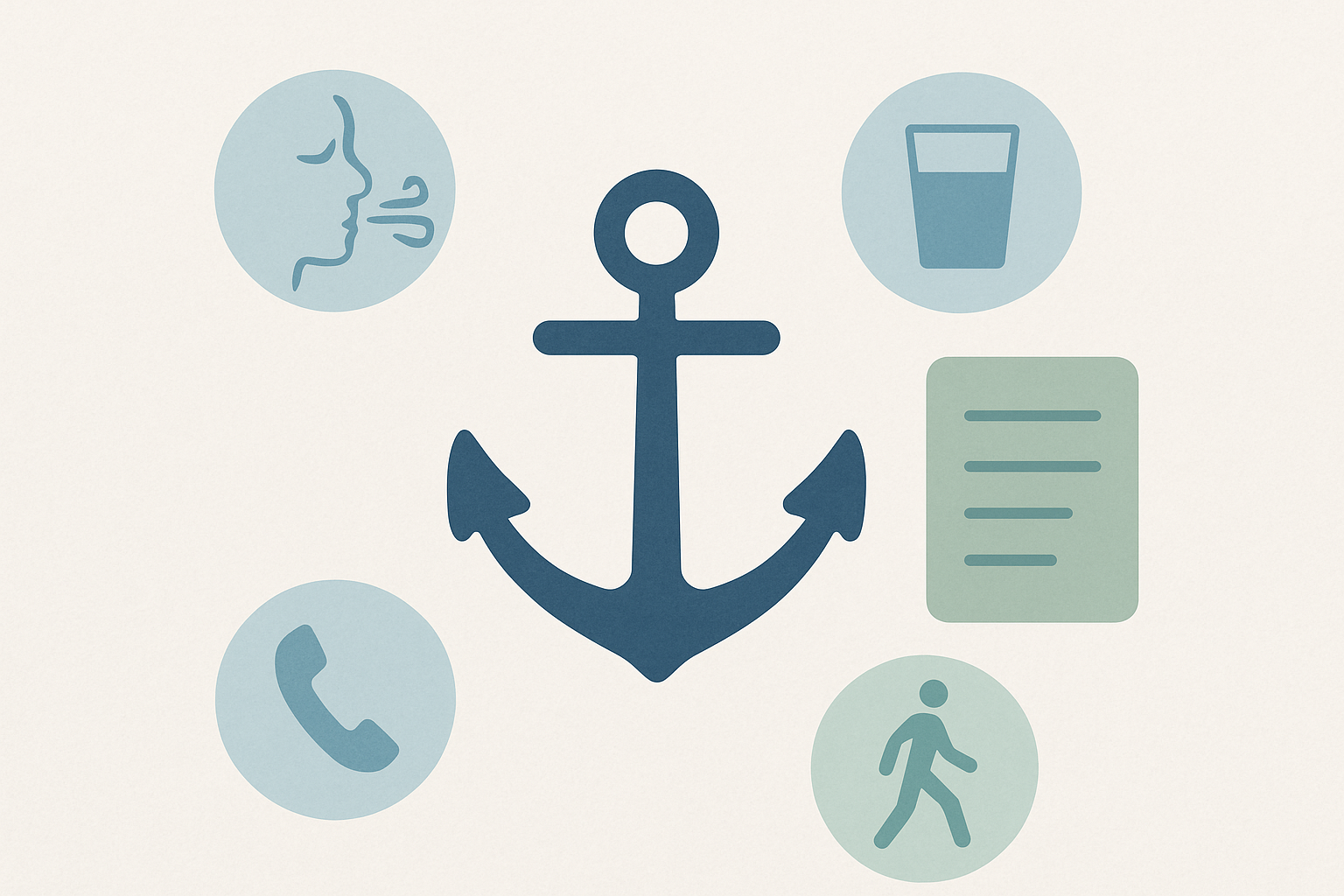

A coping skills menu is a ready-made list of healthy ways to steady yourself, written down ahead of time and sorted so that when you are stressed or overwhelmed, you can just pick one instead of trying to think clearly in a moment when thinking clearly is hard.
I build small wellbeing and productivity tools under softDev23, and the menu format keeps proving useful because it solves a specific problem. The skills that help in a hard moment are easy to name when you are calm and almost impossible to remember when you are not. A menu does the remembering for you.
Before anything else, one honest note. A coping skills menu is a helpful everyday tool for ordinary stress and overwhelm. It is not a substitute for professional support, and if you are struggling badly or in crisis, please reach out to a qualified person or a local helpline. With that said, here is how to build a menu that actually helps on a normal hard day.
What is a coping skills menu?
A coping skills menu takes the restaurant menu shape and fills it with healthy coping strategies instead of food. The strategies are grouped so you can match what you pick to what the moment needs, because not every hard moment is the same.

It is a close cousin of two things I have written about before. One is the ADHD dopamine menu, which leans toward activities that lift a flat mood. The other is the self-care menu, which is about gentle, restorative upkeep. A coping skills menu is specifically for the harder moments, the spikes of stress, anxiety, or overwhelm, when you need to steady yourself rather than treat yourself.
The shared idea is the same one that runs through all of them. You decide in advance, while you are calm, and leave yourself a short list of good options for later, when deciding is the part you cannot do.
Why it helps to decide in advance
In a stressful moment, your thinking narrows. That is normal and even useful in a real emergency, but for everyday overwhelm, it works against you, because the calm, sensible part of your brain is exactly the part that goes quiet. You are left reaching for whatever is closest, which is often the least helpful thing.
A coping skills menu sidesteps that. You did the clear thinking earlier, when you had access to it. The menu is a message from your calm self to your overwhelmed self, and it says, here are a few things that have actually helped before, just pick one.
That is also why a menu beats trying to memorize a list of techniques. Under stress, you will not recall them. But you can read a short card and point at something, and that small act of choosing is often enough to create the tiny pause that lets the moment settle.
How to sort a coping skills menu
I sort a coping skills menu by what the moment needs, not by effort. Four groups cover most situations, and you can copy them.
Grounding is for when you feel scattered or panicky and need to come back into your body and the present. Slow breathing, naming five things you can see, cold water on your hands, and feeling your feet on the floor. These are the fastest, and they belong at the top.
Soothing is for when you are activated and need to bring the intensity down. A warm drink, a comforting playlist, a blanket, stepping somewhere quiet, a slow walk. These do not solve the problem; they lower the volume so you can.
Releasing is for when there is energy or emotion that needs somewhere to go. A brisk walk, shaking it out, writing the feeling down, a good stretch, tidying something with your hands. Movement and expression give the feeling an exit.
Connecting is for when isolation is making it worse. A text to a friend, a short call, sitting near someone, or even a message to a community. You do not have to explain everything. Often, just not being alone with it is the help.
How to build yours
You can build a usable coping skills menu in about fifteen minutes, ideally on a calm day rather than a hard one.
Start by remembering what has actually worked. Think back to recent hard moments that passed, and ask what helped them pass. Real past wins beat generic advice, because you already have evidence they work for you.
Then add a few proven techniques you have not tried much, like paced breathing or grounding, so the menu is not only old habits. Keep these realistic, the kind of thing you would genuinely do.
Sort what you have into the four groups, and keep each group short. Three or four options per group is plenty. A long menu is harder to use in a hard moment, not easier.
Finally, make it reachable before you need it. Save it where you can get to it in seconds, on your phone, by your desk, or on the fridge. A coping skills menu that lives in a notebook you cannot find is no help at 11 pm.
A simple grounding technique to start
If you only put one thing on your menu today, make it a grounding technique, because grounding is the fastest way to interrupt a spike of stress and come back to the present.
A common one is the five-sense count. Name five things you can see, four you can hear, three you can touch, two you can smell, and one you can taste. It works because it gently pulls your attention out of the spiral and into the room, and it is concrete enough to do even when your thoughts are racing.
Another is slow-paced breathing, where you make the out-breath longer than the in-breath for a minute or two. There is good, free guidance on grounding and relaxation from nonprofits like HelpGuide if you want to learn a few more.
The reason these belong at the top of the menu is speed. In a hard moment, you want the option that needs no setup, no equipment, and no decision beyond starting. Grounding fits, which is why it earns the first slot.
An example coping skills menu
Here is a short, filled-in version to adapt. Keep yours this brief, because a long menu is harder to use when you are overwhelmed, not easier.
Grounding might be the five senses count, cold water on your hands, or feeling your feet on the floor. Soothing might be a warm drink, a calm playlist, or stepping into a quiet room. Releasing might be a brisk walk, writing the feeling down, or shaking your hands out. Connecting might be a short text to one person, sitting near someone, or a quick call.
Twelve options across four groups are plenty. You are not trying to be comprehensive. You are trying to give your overwhelmed self three or four good doors in each direction, so that whatever the moment needs, there is something easy to point at.
What to leave off the menu
Be honest about which coping strategies actually cost you. Some things feel like coping in the moment and leave you worse off after, and those do not belong on the menu, even though the urge to reach for them is real.
The menu is specifically the list of healthy options, the ones that help and do not add to the pile later. Naming the unhelpful ones is useful too, but keep them off the menu itself, because the whole point is that everything on it is a choice you will be glad you made.
This is the same low-guilt principle behind the apps I build, which I keep an honest list of in my post on the best apps for ADHD. The tools that actually help are the ones that meet you on a hard day without making you feel worse for needing them.
For anxiety in particular, I sorted specific techniques by what the moment needs in my post on coping skills for anxiety.
Make your coping skills menu now
If you would rather not face a blank page, I built a free tool that makes this quick. It is a coping skills menu builder that walks you through the groups, suggests gentle options for each, and lets you save, share, or print the result. There is no account and nothing to install, and it runs in your browser.
It is part of Pluck, a small free menu builder I make under softDev23, so treat that as the maker pointing you to his own tool. The method here works just as well on an index card. The builder only exists to remove the friction of starting.
Two reminders to close. Keep the grounding options genuinely simple, because simple is what you can reach for when overwhelmed. And keep the honest note in mind. A coping skills menu is a good tool for ordinary hard moments, not a replacement for real support when you need more than a tool. If a hard moment is bigger than a menu, reaching out to a person is itself the best coping skill on the list.