
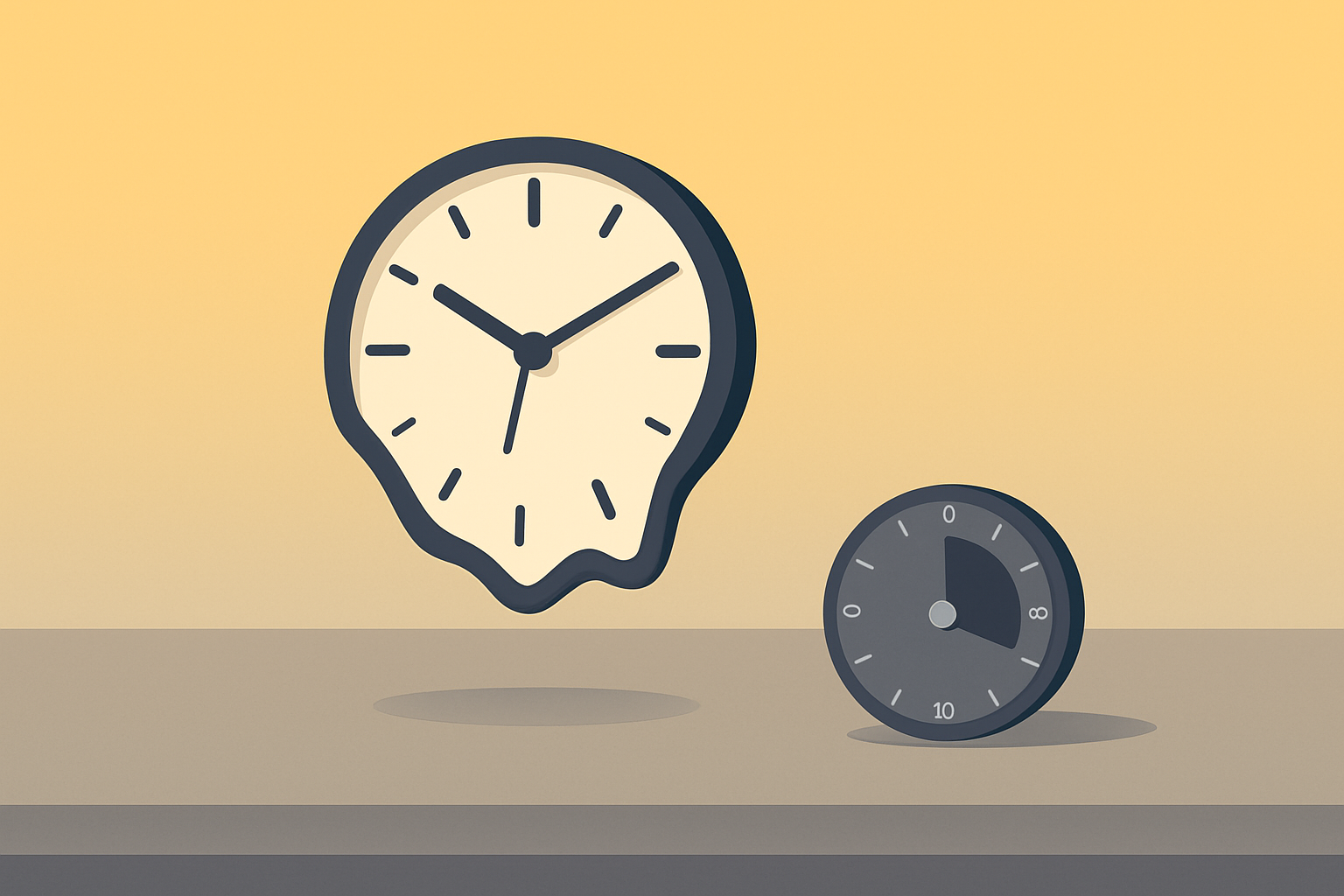

An ADHD time blindness test cannot diagnose anything on its own. What it actually does is put a number on something you already suspect, that you consistently misjudge how much time has passed or how long a task will take.
I built my own morning around the assumption that I cannot trust my internal sense of time at all, which is the entire reason a visual timer earned a permanent spot on my desk.
A self-assessment test is a reasonable first step toward that same realization, even if it cannot replace an actual evaluation.
What time blindness actually is

Time blindness is the inability to sense how much time has passed, or to accurately estimate how long a task will take before you start it. It is not an official diagnosis on its own, but it shows up constantly in adult ADHD.
The pattern is not laziness or carelessness. It is a genuine perception gap, the internal clock that other people seem to check automatically simply does not fire the same way.
The signs a test is actually measuring
Chronic lateness, missed deadlines, and persistent procrastination are the headline signs, but the underlying pattern is more specific than just being late.
Underestimating or overestimating how long a task will take, losing track of time entirely during a hyperfocus session, and genuine difficulty building or sticking to a schedule are the actual components a test is trying to separate out from ordinary busyness.
Losing hours inside a video game or a deep-dive research rabbit hole without noticing is a specific, recognizable version of the same underlying gap, not a separate problem.
What a self-assessment score actually tells you
Most quizzes in this space score results into rough bands, mild, moderate, or significant time blindness, based on how many of the pattern questions land as true for you.
Treat the band as a starting point for self-understanding, not a verdict. These are educational self-assessment tools built to help you notice a pattern, not diagnostic instruments a clinician would use to confirm anything.
Why the tests vary so much between sites
Different quizzes ask different questions and use different scoring bands, so the same person can land in a different category depending on which one they happen to take.
That inconsistency is expected for an unregulated self-assessment tool, not a sign that either test is broken. Look at the pattern across several rather than treating one specific number as precise.
When the score is worth taking further
A moderate or significant result is worth a real conversation with a healthcare professional, especially if the pattern is actually affecting work, relationships, or how you feel about yourself day to day.
Time blindness on its own is not automatically ADHD, other things can produce a similar pattern, which is exactly why a self-test is a starting point for a real conversation rather than a stopping point on its own.
What actually helps once you know the pattern is real
Knowing you cannot trust your internal clock is more useful than it sounds, because it changes what you build around the problem instead of just feeling bad about being late again.
External, visual cues that do not require reading a number do the actual work. A shrinking disc or a draining bar registers in a way a digital countdown simply does not, since you catch it out of the corner of your eye rather than having to consciously check it.
Pairing awareness with a daily structure
A visual timer solves the in-the-moment perception gap. A capped daily structure solves the planning side of the same problem.
That is why I run my own days on something close to a 1-3-5 task structure rather than an open-ended list that assumes I can accurately judge how much actually fits in a day.
Neither tool fixes the underlying perception gap. Both make the gap matter less in practice, which is the realistic goal rather than expecting either one to cure anything.
ADHD time blindness test, quick answers
Is an ADHD time blindness test an actual diagnosis? No. It is a self-assessment tool that helps you notice a pattern. Only a healthcare professional can evaluate for ADHD or another underlying condition.
What score means I should talk to someone? Moderate to significant results, especially if the pattern is affecting your work, relationships, or daily functioning, are worth bringing to a professional conversation.
Can time blindness happen without ADHD? Yes. Time blindness is a symptom pattern, not an ADHD-exclusive marker, which is part of why a self-test alone cannot diagnose anything.
What actually helps day to day? Visual, external time cues instead of digital countdowns, and a capped daily task structure instead of an open-ended list, address the practical impact even without fixing the underlying perception gap.
Where this fits
I write about the coping tools and systems I actually use managing ADHD and running a one-person software business. If a connected system for managing the rest of that workload interests you, join the Tandri waitlist.