
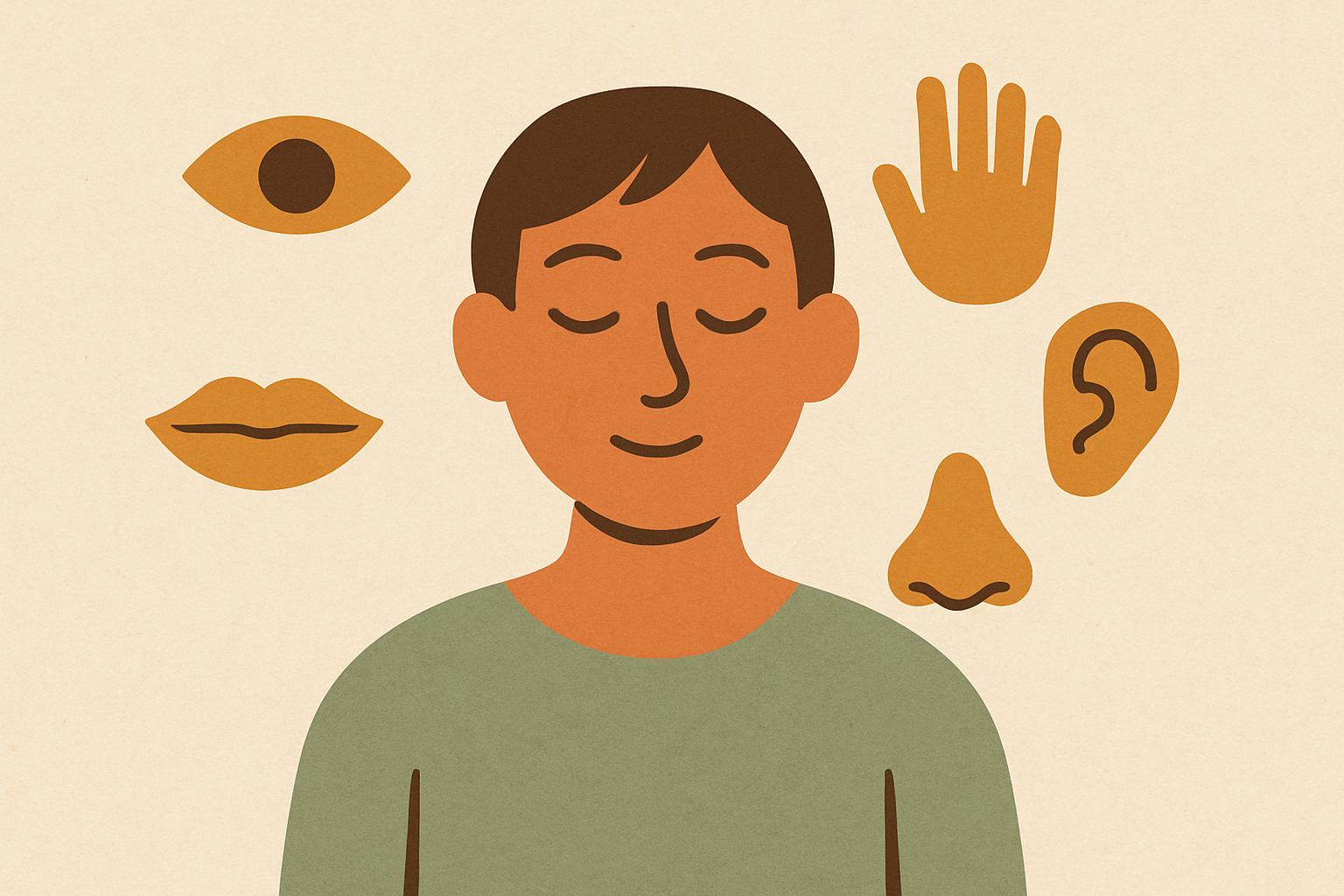

When anxiety spikes, your mind races ahead into everything that might go wrong, and the harder you try to think your way calm, the worse it gets. The 5-4-3-2-1 grounding technique is a simple, almost mechanical way out of that spiral. You do not argue with the anxious thoughts. You walk your attention through your five senses, one at a time, until you are back in the room instead of stuck in your head.
It takes under a minute, needs no app or equipment, and works anywhere. I build small wellbeing tools under softDev23, and this is one of the few techniques I recommend without caveats, because it is so easy to actually do on a bad day.
One honest note before the how-to. The 5-4-3-2-1 technique is a genuinely useful tool for everyday anxiety, stress, and overwhelm. It is not a treatment for an anxiety disorder, and if anxiety or panic is a regular part of your life, it is worth talking to a qualified professional. With that said, here is exactly how it works.
What is the 5-4-3-2-1 grounding technique?
The 5-4-3-2-1 grounding technique is a sensory exercise that pulls your attention out of anxious thoughts and into the present moment by naming five things you can see, four you can touch, three you can hear, two you can smell, and one you can taste.
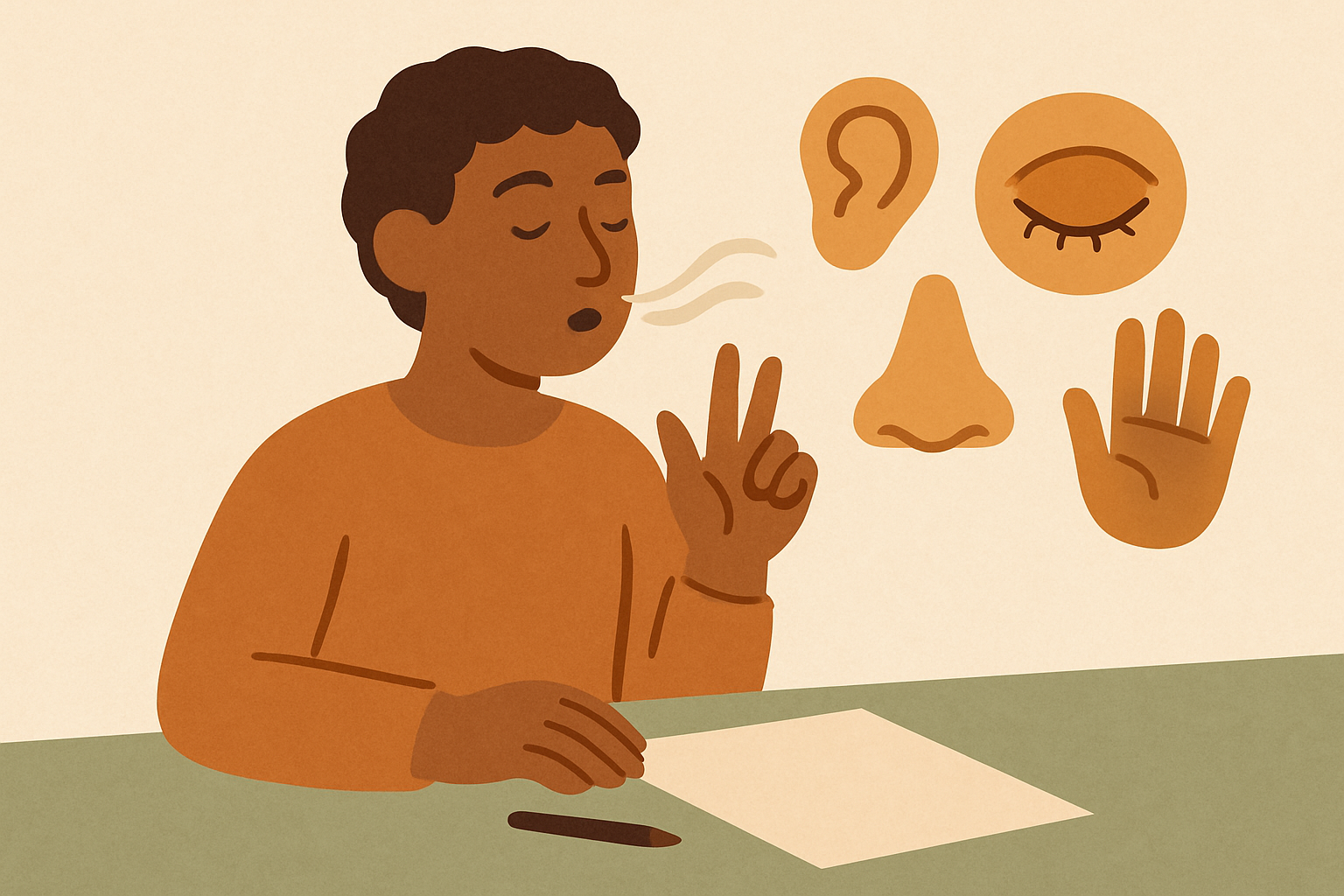
Grounding just means bringing yourself back to the here and now. Anxiety lives in the future, in every “what if”, and in the past, in every “why did I”. Your senses only ever report the present. So by deliberately noticing what is actually around you, right now, you give your brain something concrete to hold instead of the spiral. The countdown structure is part of the trick: it gives the exercise a clear shape and a finish line, so your mind has a simple task to follow.
The method was popularized by clinicians as a fast way to interrupt anxiety and panic, and it shows up everywhere from university counseling centers to therapy worksheets. The version from the University of Rochester Medical Center is the one most people learn.
The five steps, one sense at a time
Work down from five to one, slowly. The slowness is the point, so do not rush to the next sense.
Five things you can see. Look around and name five. A mug, a door handle, a patch of light on the floor, your own hand, a cloud. Small and ordinary is fine; you are just collecting them.
Four things you can feel. Notice four physical sensations. The chair under you, the floor through your feet, the fabric of your sleeve, the air on your skin. Actually feel each one rather than just listing it.
Three things you can hear. Listen for three separate sounds. Traffic outside, a fan humming, your own breathing. If it is quiet, that counts; quiet is a sound too.
Two things you can smell. Find two scents. Coffee, soap, fresh air from a window. If you cannot smell anything obvious, move and sniff something nearby, or just notice the neutral smell of the room.
One thing you can taste. Notice one taste. The last thing you drank, toothpaste, or just the inside of your mouth. Take a sip of water if you have it.
By the time you reach one, most people find the edge has come off. If it has not, do it again. There is no rule against a second lap.
Why the 5-4-3-2-1 technique calms anxiety so fast
Anxiety is your nervous system’s fight-or-flight response firing when there is no real danger. It narrows your attention onto the threat and floods you with the urge to do something. You usually cannot talk yourself out of that state, because the part of your brain that reasons is exactly the part that goes quiet under stress.
The 5-4-3-2-1 technique works around that instead of fighting it. Naming sensory details is a small, concrete task your brain can do even when it is overwhelmed, and doing it gently redirects attention away from the threat loop and onto the present, which signals to your nervous system that you are, in fact, safe right now. It is less “calm down” and more “give your mind one simple thing to hold until the wave passes”.
It also creates a pause. A lot of anxiety’s momentum comes from reacting fast. Counting down through your senses inserts a deliberate gap between the feeling and the reaction, and that gap is often enough to let the moment settle.
When should you use it?
The technique is most useful the moment you notice anxiety climbing, before it peaks. Some good cues to reach for it: your thoughts start racing or looping, your chest tightens, you feel suddenly overwhelmed in a meeting or a crowd, or you wake at night with your mind spinning.
It is also worth practicing when you are calm, not just in a crisis. Running through it a few times on an ordinary day makes it familiar, so that when you actually need it, your brain already knows the moves and you are not learning a new skill mid-panic.
How to make it actually work in the moment
A few small things make the difference between a technique you know about and one that actually helps.
Go slowly. The instinct under stress is to rush, but speeding through the senses defeats the point. Let each one take a few seconds.
Name them deliberately, under your breath or in your head. Saying “blue mug, brown door, my hand” engages language and makes the noticing more real than a vague glance around the room.
Pair it with one slow breath between senses if you can, with a longer exhale than inhale. You do not have to, but it compounds the calming effect.
Do not grade yourself. If you lose count or your mind wanders back to the worry, that is normal. Just pick up where you left off. There is no failing this.
Are there shorter or longer versions?
If five-to-one feels like too much, the 3-3-3 rule is a lighter version: name three things you see, three you hear, and move three parts of your body. It is faster and easier to remember in a real panic.
If you have more time, you can stretch the full version by describing each thing in more detail, not just “a mug” but “a chipped grey mug, still warm”. The more specific you get, the more your attention stays anchored. Pick whichever depth matches the moment.
Does it work for everyone?
Grounding helps most people take the edge off everyday anxiety, but it is not magic, and it does not land the same way for everyone.
For some, the sensory focus is the thing that finally breaks the loop; for others, breathing or movement works better. That is normal.
The point is to have a couple of options you trust, so when one does not click, you can reach for another instead of concluding that nothing works. If 5-4-3-2-1 does not do much for you on a given day, it is information, not failure, and a different tool may suit that moment better.
Keep your grounding options where you can find them
The hard part about any coping skill is remembering it exists when you are overwhelmed, which is exactly when you are least able to think clearly. That is why it helps to keep your go-to techniques written down somewhere you can reach in seconds, the same way you would keep a coping skills menu for hard moments.
If you want a quick way to build one, I made a free coping skills menu builder that walks you through grounding, soothing, and other options and lets you save or print the result, so 5-4-3-2-1 is one tap away when you need it. It pairs well with a self-care menu for gentler days and a dopamine menu for when the problem is getting started rather than calming down. If you are looking for supportive apps too, I keep an honest list of the best apps for ADHD, many of which help with exactly this kind of regulation.
If anxiety is the recurring problem, not just the occasional spike, my roundup of coping skills for anxiety sorts more options by symptom.
The honest limits
The 5-4-3-2-1 grounding technique is a genuinely good tool for everyday anxiety, stress, and the occasional spike of panic. It is not a cure, and it will not resolve the underlying causes of ongoing anxiety on its own.
If anxiety or panic attacks are frequent, intense, or getting in the way of your life, please treat that as a sign to reach out to a doctor or a mental health professional. A grounding technique is something you use alongside real support when you need more than a tool, not instead of it. Used that way, for the ordinary hard moments, it is one of the simplest and most reliable ways to get back to the present when your mind has run off without you.