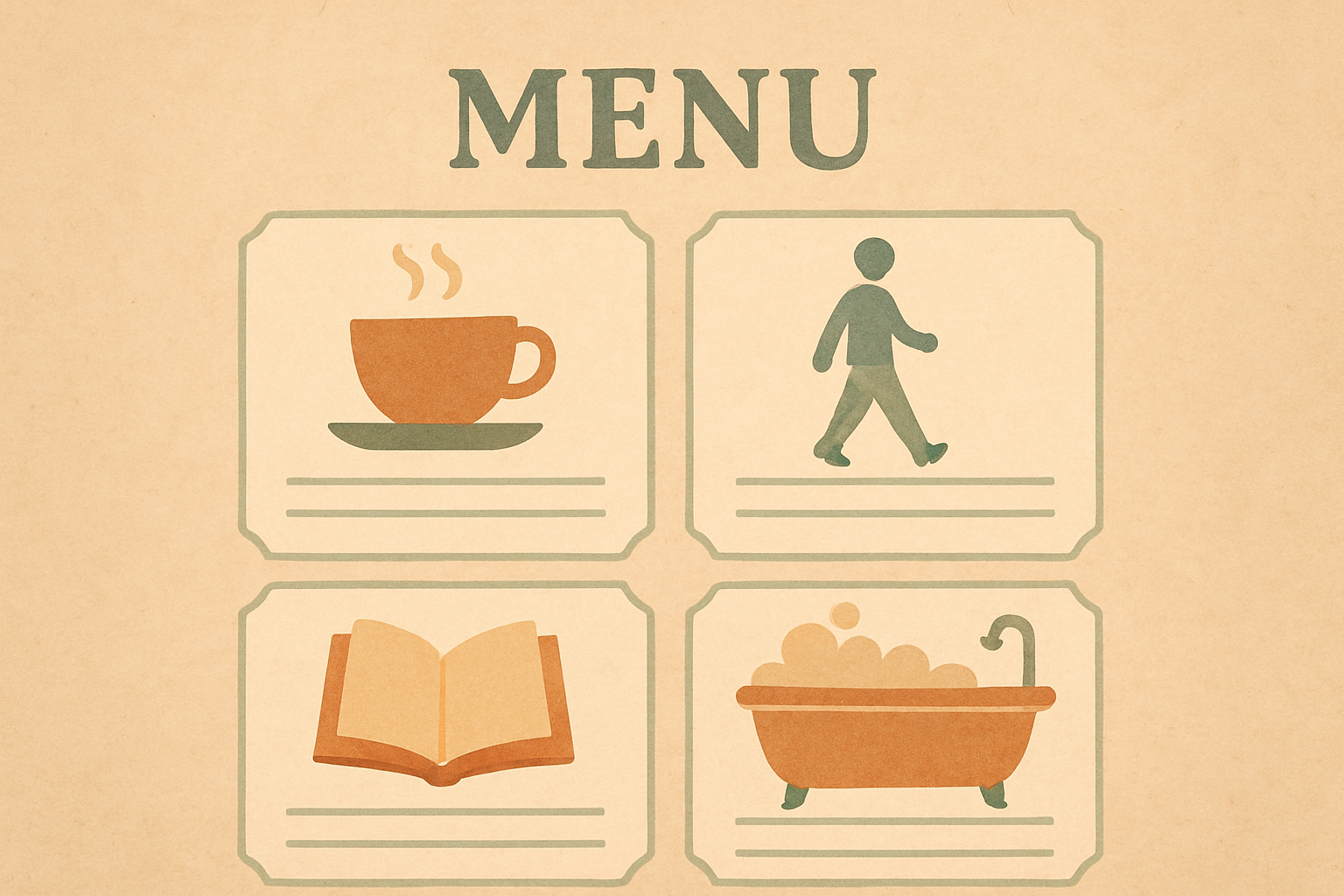

A self-care menu is a short, pre-made list of small things that reliably help you feel a little better, written down ahead of time and sorted by how much effort each one takes. When you are stressed, flat, or overwhelmed, you do not brainstorm from scratch. You read the menu and pick something.
I build small productivity apps and wellbeing tools under softDev23, and this is the one self-care idea I keep coming back to, because it removes the part that usually defeats us.
The deciding factor.
Most self-care advice fails not because the activities are wrong, but because the moment you most need them is the moment you have the least energy to choose.
So this is what a self-care menu is, why it works, and exactly how to build one. There is also a free tool at the end that makes yours in a couple of minutes if you would rather skip the blank page.
What is a self-care menu?
A self-care menu borrows its shape from a restaurant menu. Instead of dishes, it lists activities that help you reset, grouped into sections by effort and time, so you can match what you pick to how much you actually have left in the tank.
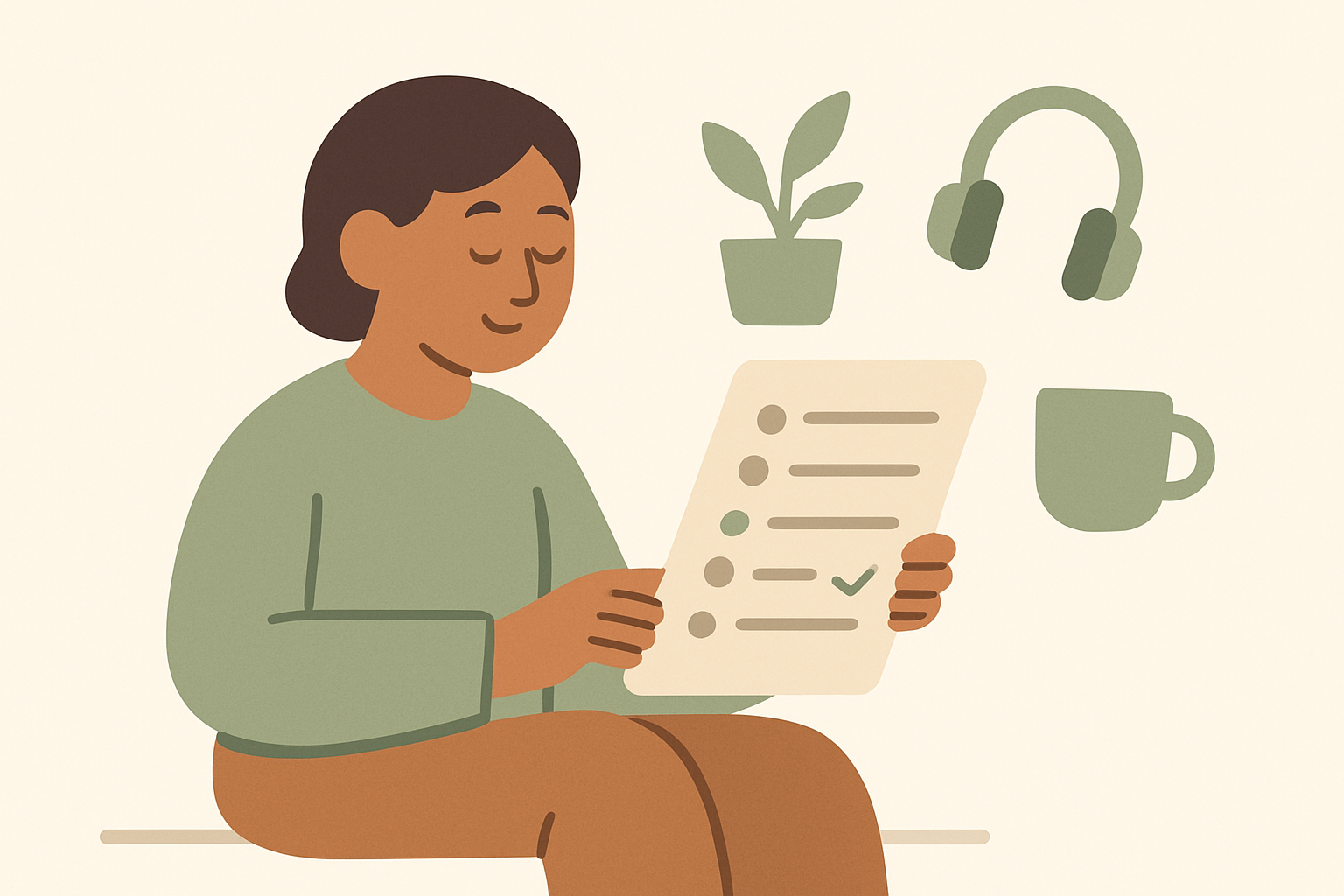
The idea is closely related to the ADHD “dopamine menu”, which I wrote about in detail in my post on building a dopamine menu. A dopamine menu leans toward activities that give your brain a lift. A self-care menu is a little broader. It includes the quiet, restorative things too, the ones that do not spike your mood but slowly refill you.
If you are short on things to actually put on that menu, I gathered a long set of self-care menu ideas to choose from.
The point of both is the same. You do the thinking in advance, while you have the energy, and leave yourself a simple set of good options for later, when you do not.
Why a pre-made menu works
Picture the usual sequence when you are running low. You have to notice you need a break, generate a list of things that might help, weigh them against each other, work out the steps each one takes, and then start. That is a lot to ask of a tired brain, so most of us default to the easiest option in reach, which is usually the phone, the feed, the thing that drains us more.
A self-care menu removes almost all of that load. The decision is already made. The options are already good ones. All that is left is to pick, which is small enough that you can usually manage it even on a bad day.
It also quietly solves the guilt problem. Self-care can turn into one more thing you are failing at, a list of shoulds you never get to. A menu reframes it. You are not behind on anything. You are just choosing one small thing from a short list, and any choice counts.
How to sort your menu by effort
The sorting is what makes a self-care menu more than a list of nice ideas. I use four sections, and you can copy them directly.
Starters are the two-minute resets. A glass of water, opening a window, a few slow breaths, stepping outside for a moment. These are for when you have almost nothing left and just need to break the freeze.
Mains are the real fifteen-to-thirty-minute restoratives. A walk without your phone, a shower, tidying one surface, cooking something simple, stretching, and a chapter of a book. These take a bit of activation energy but pay you back.
Sides are the things you do alongside something else to make it bearable. Music while you work, a warm drink within reach, a candle, a comfortable spot by a window. They do not fix the day; they soften it.
Specials are the bigger, rarer resets that need planning. A day outdoors, time with people who refill you, a proper rest day. You will not reach for these often, but it helps to have them named.
How to build yours in ten minutes
You can have a usable self-care menu in about ten minutes.
Start by brainstorming freely. Write down everything that reliably makes you feel even slightly better, without judging it. Do not filter for what sounds healthy or impressive. The only test is whether it actually helps you.
Then cut the ones with a hangover. Be honest about which “treats” leave you worse off afterward, like the doomscroll or the thing that triggers regret. Those are not on the menu. A self-care menu is specifically the list of things that help and do not cost you later.
Next, sort what is left into the four sections by effort and time. This is the step most people skip, and it is the one that makes the menu usable on a hard day, because it lets you match your pick to your energy.
Finally, make it visible. A note on the wall, a pinned file, a card on your desk, your phone wallpaper. A menu you cannot find when you are low is not a menu.
A few rules that keep it useful
A couple of things I learned the hard way. Keep the starters genuinely tiny, because the entire point is that they are doable when nothing feels doable. If your smallest option still takes effort, add a smaller one.
Refresh it every so often, because what restores you drifts over time. A menu you wrote six months ago in a different season of life may not fit the current one, and a stale menu quietly stops working.
And do not aim for an aesthetic masterpiece. The prettiest self-care menu on Pinterest is worthless if you never actually use it. An ugly list you reach for beats a beautiful one you made once and forgot. If you want the wider picture on looking after your wellbeing, charities like Mind have free, level-headed guides, and I keep an honest list of the tools I use in my post on the best apps for ADHD.
An example self-care menu
It helps to see one filled in, so here is a simple version you can adapt. Treat it as a starting point, not a template to copy exactly, because the whole value is that yours fits you.
Starters might be a glass of water, opening the curtains, three slow breaths, or putting on one song you like. Mains might be a ten-minute walk, a shower, making a proper cup of tea, tidying a single surface, or a few pages of a book. Sides might be a candle while you work, a playlist that signals “rest now”, or sitting by a window. Specials might be a morning with no plans, a long bath, or time with a person who leaves you feeling lighter.
Notice how unglamorous most of it is. That is the point. A self-care menu is not a spa day you can never afford or schedule. It is the small, ordinary, repeatable things that actually move your mood, made easy to find on a day when you cannot think of a single one.
When to reach for it
A self-care menu is most useful at the moments you are least likely to remember it exists, so it helps to name a few triggers in advance. When you notice you are scrolling without enjoying it, that is a cue. When you feel flat and cannot say why, that is a cue. When you have just finished something draining, that is a cue to spend from the menu before the tank hits empty.
The habit of building is small. Instead of pushing through the dip or reaching for the nearest distraction, you open the menu and pick one thing. Over time, that becomes automatic, and the menu stops being a document you made once and becomes a reflex you actually use.
Self-care menu vs to-do list
It is worth being clear about what a self-care menu is not. It is not a to-do list, and treating it like one is the fastest way to ruin it.
A to-do list is made of obligations you owe. A self-care menu is made of permissions you are giving yourself. Nothing on it is mandatory, nothing is overdue, and you never finish it. If you ever feel like you are failing your self-care menu, you have accidentally turned it back into a to-do list, and it is time to soften it again.
That distinction matters most for anyone whose brain already runs on guilt and pressure. The menu only works as a low-stakes set of options. The moment it becomes another scoreboard, you will start avoiding it, the same way an over-strict habit app eventually gets deleted.
Build your self-care menu now
If you would rather not start from a blank page, I built a free tool that makes this quick. It is a self-care menu maker that walks you through the sections, suggests starter activities for each, and lets you save, share, or print the result. No account, nothing to install, and it runs right in your browser.
It is part of a small free menu builder called Pluck that I make under softDev23, so treat that as the maker telling you about his own tool. The method in this post works just as well on paper. The tool only exists to remove the friction of the blank page, which for a lot of people is the whole barrier.
However you make it, the value is the same. A self-care menu turns “I should take care of myself” from a vague, heavy should into a short list of small, specific, doable things. On the days when deciding is the hard part, that is most of the battle. Keep it tiny, keep it visible, and let any choice count.