
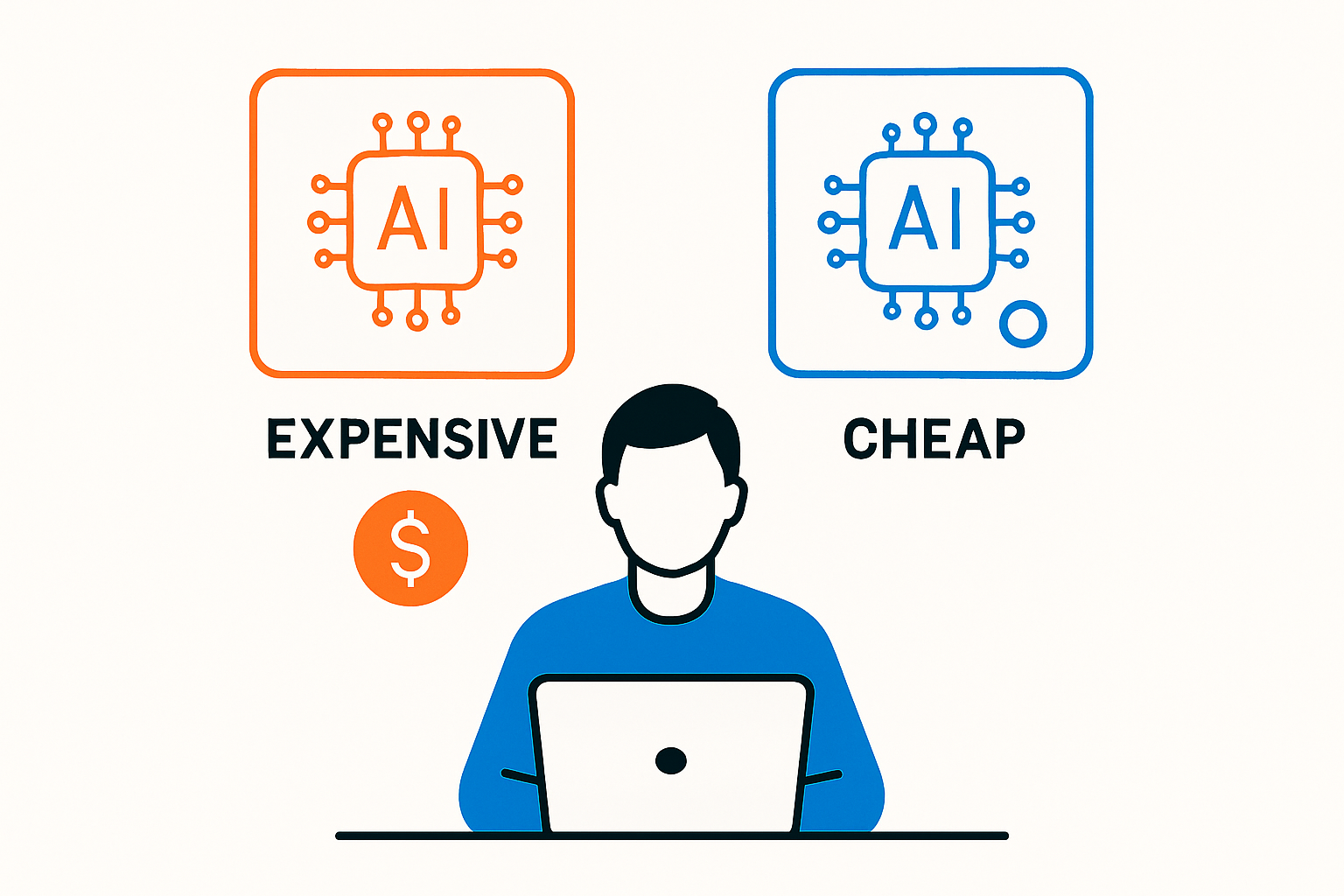

Coinbase quietly cut its internal AI bill nearly in half this year. The move that did it was switching a big chunk of its engineering workload from Claude and GPT to open-weight Chinese models like GLM 5.2 and Kimi.
That is not a rumor, it is reported directly, and it is exactly the question every solo developer watching their own API bill eventually asks.
So is DeepSeek actually a replacement for Claude, or just a cheaper tool for different work? I run my own token costs closely enough to care about this every month, so here is the honest breakdown.
What DeepSeek actually is

DeepSeek is an open-weight model, meaning the trained parameters themselves are published. Anyone can download the file, run it on their own hardware or through a cheap API host, and there is no vendor deciding your rate limits or your uptime.
Claude is the opposite of that. It only runs on Anthropic’s infrastructure, under Anthropic’s pricing, with no option to self-host. That single difference explains most of the cost gap between the two.
The real cost gap
Zhipu’s GLM 5.2 prices around $1.40 per million input tokens. Anthropic’s Opus 4.8 sits around $5 per million input tokens for comparable work, roughly five times more. That gap is the entire reason Coinbase’s finance team got interested in the first place.
DeepSeek’s own pricing sits in a similar range to GLM, cheap enough that routing high-volume, lower-stakes tasks there instead of Claude adds up fast once you are running an agent all day instead of asking it a question once in a while.
Where Claude still wins
Cost is not the only variable. Claude’s agentic tool use, the reliability of multi-step coding tasks, and how well it follows a long, specific set of instructions without drifting are still ahead of most open-weight alternatives in my own daily use.
For anything high-stakes, a production bug fix, a customer-facing feature, code that ships without a second human review, I still reach for Claude first. The five-times price difference buys real consistency, and consistency is worth paying for on the work that actually matters.
A practical way to split your stack
The useful move is not picking one model forever. It is routing tasks by how much they actually need. Bulk summarization, first-draft copy, and repetitive data cleanup can run through DeepSeek or GLM at a fraction of the cost.
Anything agentic, anything touching production code, and anything where a wrong answer costs you real time later stays on Claude. That split is exactly the logic behind why token cost compounds so fast in coding agents in the first place.
Cheap models handle cheap tasks. Expensive models get reserved for the tasks that actually justify the price.
The political noise you do not need to worry about
You may have seen headlines about Congress investigating companies for using Chinese AI models. That is real, but it is a corporate compliance story, not a reason an indie developer cannot use these tools today.
I broke down exactly what that fight is actually about, and why it does not change what is legal for you to build with, in open weight AI models explained.
DeepSeek vs Claude, quick answers
Is DeepSeek actually cheaper than Claude? Yes, often by four to five times per token, depending on the specific model and task.
Is DeepSeek as good as Claude for coding? For simple, well-scoped tasks, often close enough. For long agentic sessions and complex multi-step work, Claude is still more consistent in my own use.
Can I legally use DeepSeek as a solo developer? Yes. The congressional scrutiny is aimed at large companies and procurement risk, not personal or small-business use of an open-weight model.
Should I switch entirely to DeepSeek to save money? Probably not entirely. A mixed stack, cheap models for bulk work and Claude for anything high-stakes, is what actually holds up in daily use.
Where this fits
I write about the actual tools and costs behind running a one-person software business, not just the headlines. If a connected system that tracks this kind of tradeoff for you interests you, join the Tandri waitlist.