
An AI slowdown headline leaves me with a practical question. What did a lab actually stop, promise or put into operation? The September statements from Dario Amodei and Sam Altman describe different parts of that story.
I rechecked the linked essay and OpenAI report on September 16. Those sources do not establish a worldwide pause, a binding four-lab agreement or a GPT-7 delay. An announced review arrangement also needs evidence that it has begun.
I want to keep the useful question small. What would an outside reviewer actually be allowed to inspect, and what could the public learn from that work?
What does AI slowdown mean here?
Amodei wants safety work to keep pace with capability gains. His definition allows training and technical progress to continue. His three-step plan begins with outside evaluators and proposes wider coordination.
Anthropic’s unilateral commitment covers the evaluator step. Read Amodei’s essay.
Here, the frontier means the most advanced AI systems being developed. Pacing concerns how those systems progress. A review of a training process and a change to a chatbot subscription are different decisions.
That distinction matters if you use ChatGPT or Claude for work. I would not change a project plan based on a headline about pacing. I would look for a dated product announcement describing the access, feature or limit that affects the project.
For the separate model-name story, my GPT-7 explainer examines what OpenAI has confirmed and what remains rumor. This new discussion does not fill in the missing release calendar.
What has Anthropic committed to?
Anthropic plans ongoing outside review with access similar to its internal risk teams, subject to specified limits.
Amodei proposes rights to publish key findings without company editorial control. Specified sensitive information could be redacted. An unfavorable result alone would not qualify.
The essay sets out intended terms, rather than a signed contract or a confirmed start date. The embedded-evaluator section sets out the proposal.
An everyday example helps explain why access matters. Imagine hiring someone to check a payroll system. You could show them a polished report with a green tick. Or you could let them inspect the records, test a calculation and ask the staff how errors get handled.
The second arrangement gives the reviewer more ways to find a problem. It still leaves questions about which records are available, who pays for the work and who can end the engagement. This is an illustration of review access, not evidence about either lab’s current practices.
What did Sam Altman promise for OpenAI?
In his September 12 response, Altman endorsed pacing and promised independent evaluators access similar to employees, with details to follow. His direct response is on X.
That dated statement supports an access promise. It does not establish matching terms for every part of Anthropic’s plan, a shared contract or a start date. OpenAI’s publication rights and access limits need their own evidence.
I would read any later announcement with that separation in mind. Two leaders can agree that outside review is useful while making different decisions about how it works.
For example, suppose a future agreement gives reviewers broad internal access but requires the company to approve every public report. Another could let reviewers publish while restricting which systems they can inspect.
Those are hypothetical arrangements with different tradeoffs. A reader would need the actual terms to compare them. The phrase independent review cannot do that job by itself.
Has OpenAI already paused any work?
OpenAI separately reported a limited pause before these newer statements. In its September 6 report on research acceleration, the company said it paused reinforcement-learning training on its latest models intended for deployment after the Hugging Face incident.
Reinforcement learning is training that uses feedback on results. OpenAI said the pause gave it time to strengthen safeguards. At the time of that report, some research workloads had resumed under stronger controls while others remained paused.
That is a dated, company-reported action with a stated scope. It is not a live status check of every training workload on September 16.
It is not evidence that all research stopped or that a global agreement took effect. The report also leaves people responsible for decisions about research priorities and whether systems should proceed.
Dates help prevent a misleading story. A September 6 account of an incident response cannot, by itself, prove that a later evaluator-access promise has been implemented. Each claim needs its own supporting record.
What evidence would show the promises are being implemented?
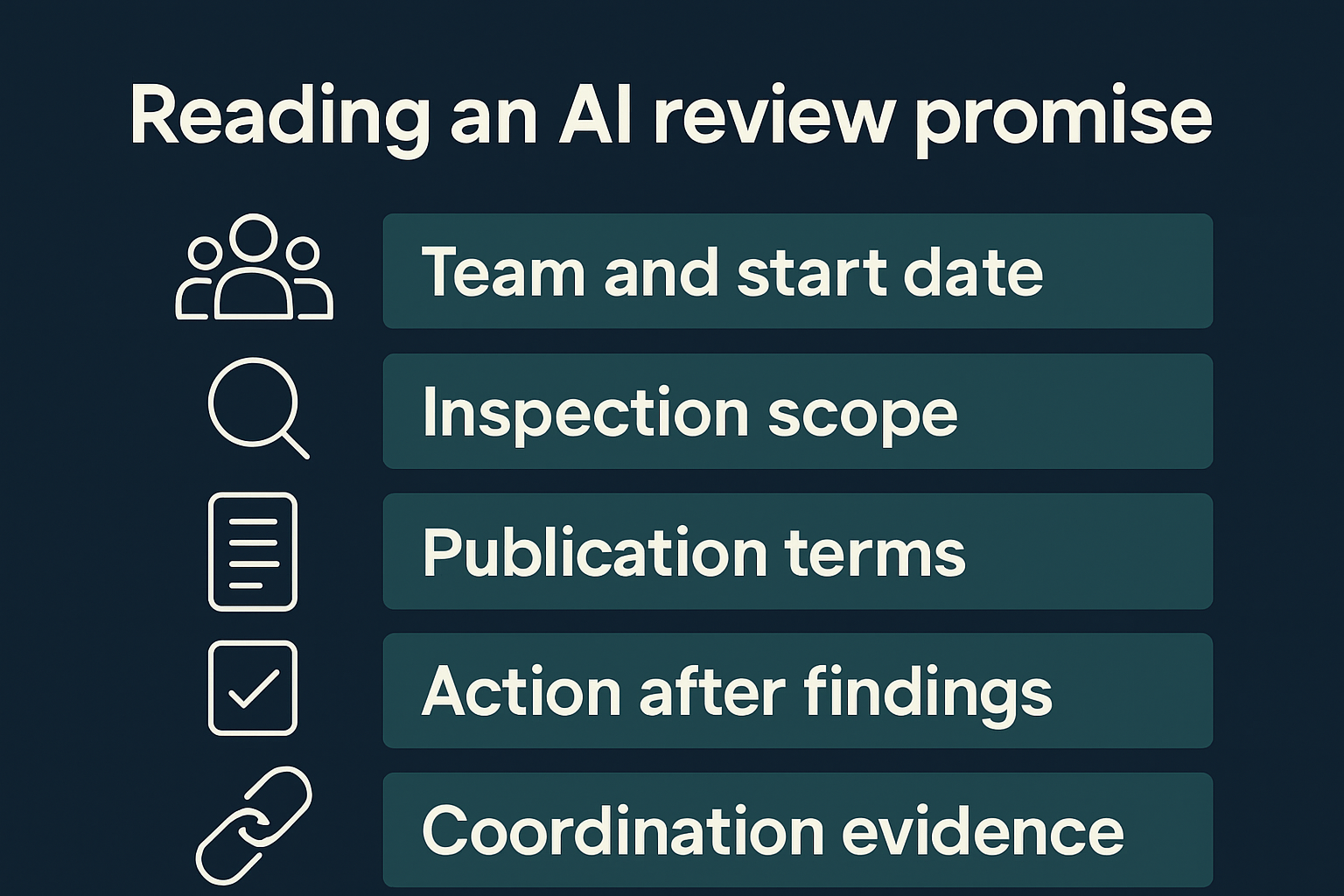
I would watch for five concrete details. This is my reading checklist for future announcements, not a claim that either company has supplied all five.
- A named team and a start date. Who is carrying out the review, and when did access begin? A planned appointment and a team already working answer different questions.
- A defined inspection scope. Can reviewers examine only a finished model, or also the process used to train and test it? A published agreement should make any important exclusions clear.
- Terms for reporting findings. Can reviewers publish an unfavorable result? Who can delay or redact a report, and can the reviewers explain what was withheld?
- An account of what changed. If a review finds a problem, what happens next? Look for a dated fix, a new test, a restriction or a decision to wait, with the reason attached.
- Evidence for wider coordination. If an announcement claims several labs now follow one rule, look for the named participants, the rule itself and how compliance will be checked.
A missing public detail is a gap in what readers can verify. It does not prove that no private work is happening. At the same time, an enthusiastic announcement cannot stand in for the missing detail.
Keep the date and link beside any claim you save. If a later report changes the picture, you can see whether it adds evidence or merely repeats an earlier promise.
How I would read the next announcement
Start with the actor, the action and the date. A CEO supporting an idea, a company signing an agreement and reviewers publishing findings are three different events.
Then read the smallest concrete claim the source supports. If a report says one training workload resumed after a fix, that tells you about that workload. It does not answer every question about the company’s next product.
I also want to know what would change my view. A published reviewer report describing both its findings and its access limits would tell me more than another round of supportive posts.
For now, the useful follow-up is to watch for evidence of access and action. Keep product plans tied to product announcements, and give these review promises room to be tested against their eventual terms.
If you want more practical explainers like this, subscribe to the softDev23 newsletter for news, guides and product updates.
Amodei essay and OpenAI report rechecked September 16, 2026. The September 12 Altman statement is supported by a preserved original-post capture checked during preparation. This article does not establish whether later private arrangements have begun.