
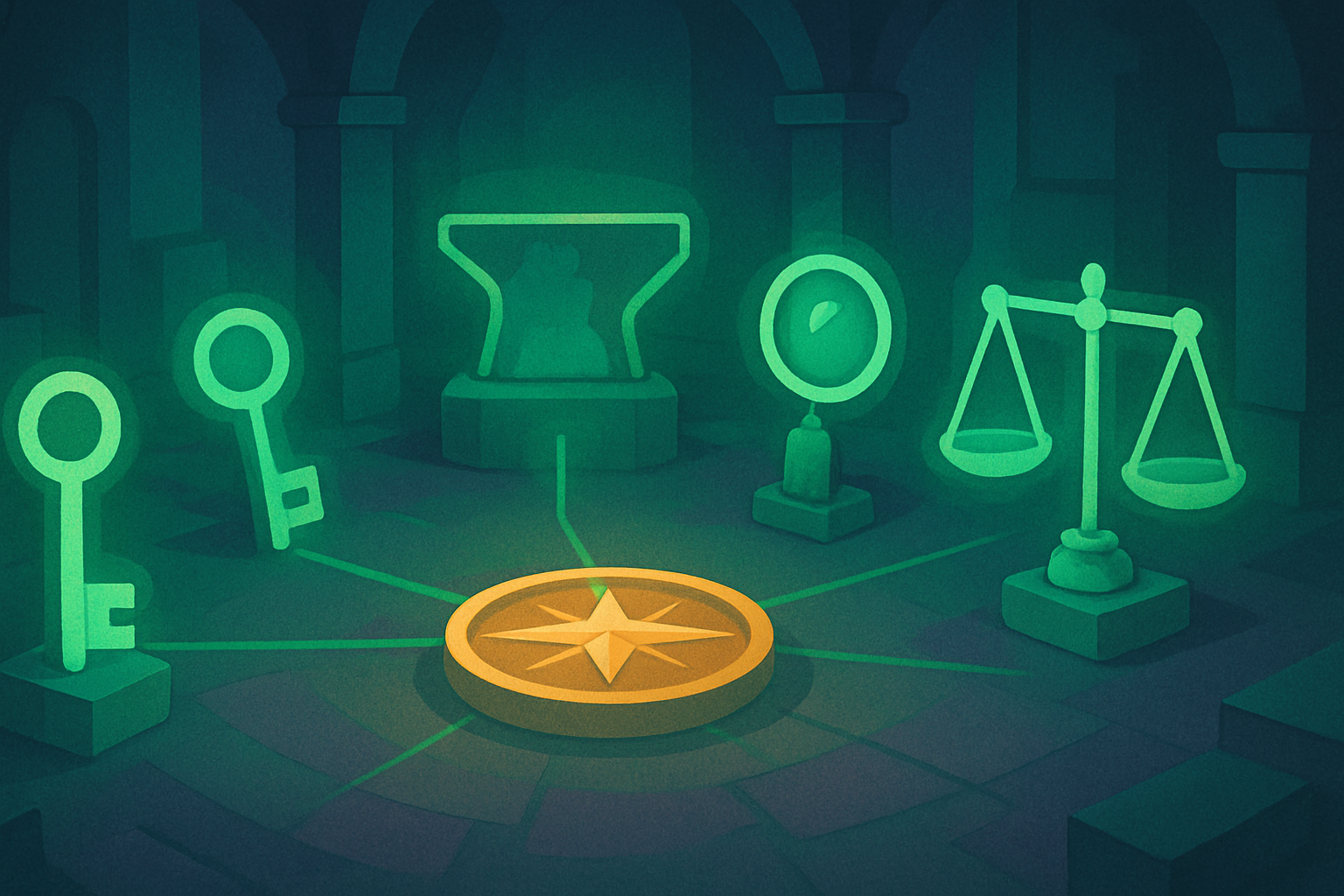

A personal AI council is a small group of independent AI roles that examine the same important decision from different angles. One role produces the work, critics search for specific failure modes, and a separate judge evaluates the revised package. The human owner still makes the decision.
I use this pattern inside my AI operating system when the cost of a hidden assumption is higher than the cost of a second review. It is useful for migrations, launches, content bets, tool choices, and other decisions that are public, expensive, or difficult to reverse.
A council is not several chatbots voting on a question. A vote can make repeated assumptions look like evidence. The value comes from separation, assigned lenses, and a clear record of what changed.
Watch a separate AI reviewer find what a passing test missed, then use the council structure below to plan your own review.
What is a personal AI council?

A personal AI council is a decision-support workflow where multiple AI reviewers work independently, compare evidence, and feed a final evaluation to a human owner. Each member has a narrow job and a shared evidence packet.
The pattern has public precedents. The open-source Language Model Council asks several language models to answer, review, and rank responses before a chairman synthesizes the result. Andrej Karpathy’s LLM Council implementation demonstrates a similar answer, review, and chairman flow.
My version is built for personal operations rather than benchmarking models. It adds explicit approval gates, a separate producer and judge, and verification after any real action.
A personal AI council needs five roles
1. The human owner sets the goal
The human owner defines the decision, acceptable risk, constraints, and approval boundary. The council can reveal consequences, but it cannot decide what consequences the owner is willing to accept.
A useful goal is measurable. “Choose the best tool” is weak. “Choose a task manager that works on Windows and Android, exports data, stays under a stated budget, and does not require a team plan” gives the council a real standard.
2. The producer creates the first package
The producer researches the problem and builds the draft, recommendation, migration plan, or implementation. It records sources and uncertainty while working.
The producer does not declare its own work complete. That separation is important because the producer remembers unstated reasoning that a new reader cannot see. A missing field can feel present when its author knows what was intended.
3. Independent critics attack different risks
Each critic receives the same goal and evidence but a different lens. An audience critic may test usefulness and clarity. A technical critic may test feasibility and failure recovery. An evidence critic may inspect sources, duplication, and unsupported claims.
The first pass is blind. Critics do not read each other’s reports before forming an opinion. This reduces anchoring and gives disagreement a chance to appear.
For a practical checklist for this phase, see my AI adversarial review method.
4. The reconciler turns objections into actions
Critic reports are not the final answer. The reconciler groups duplicate findings, checks each one against evidence, and records whether it is accepted, rejected, or still uncertain.
Every accepted finding needs a correction. Every rejected finding needs a reason. Without this ledger, the council produces commentary instead of control.
5. A separate judge applies the rubric
The judge receives the revised package, critic reports, evidence ledger, and success criteria. It returns one of three useful outcomes: proceed, reshape, or stop.
The judge must be separate from the producer. It should cite the artifact for each gate and state remaining uncertainty. Confidence without traceable evidence is not a pass.
OpenAI’s evaluation guidance emphasizes explicit criteria and representative examples. Its GDPval report also describes automated grading as useful without treating it as a complete replacement for expert review.
How a personal AI council differs from one long chat
One long chat carries momentum. The assistant sees the original request, the draft it produced, the praise or correction that followed, and the preferred direction. Asking it to become a neutral critic does not erase that trajectory.
A council creates independent context windows for the first review. That makes it more likely that one critic will question the premise while another inspects the execution.
Anthropic’s description of its multi-agent research system highlights the benefit of independent exploration and the difficulty of coordinating agents. The lesson is not “add agents everywhere.” The lesson is to give each agent a bounded task and design the handoff.
A council also produces artifacts. The goal, source packet, reports, decisions, and verification record can be inspected later. A long chat often leaves the final conclusion without a clean map of why it changed.
When to use a personal AI council
Use the full pattern when at least one failure mode would be costly:
- Publishing a claim that could damage trust
- Migrating or deleting important data
- Selecting a paid tool that will hold core work
- Launching a product or changing its positioning
- Choosing between technically plausible architectures
- Automating a workflow that can write to public systems
Skip the council when the choice is easy to reverse, a direct test is cheaper, or the evidence is already decisive. Use one critic for a medium-stakes review and save the full council for decisions that deserve the overhead.
This proportional approach is part of Loop Engineering: frame the goal, research the state, build, challenge, verify, and record what happened.
A personal AI council is an architecture, not a prompt
The architecture has four boundaries. The owner sets the goal and approval scope. The producer builds. Critics inspect without sharing a first-pass context. The judge evaluates the reconciled package. A verification record then proves what happened in the real system.
Those boundaries can be implemented with different models, separate chats, local agents, or a workflow tool. The product is the record and role separation, not the orchestration brand.
A one-page personal AI council template
Store one note with these seven blocks. The note can live in a project folder, an Obsidian vault, or another system you already review.
Decision
Write one sentence naming the choice and the deadline. Add the definition of done and the failure that matters most.
Evidence ledger
List each important claim with a source, date, and status: fact, assumption, or owner preference. Keep unresolved questions visible.
Role roster
Name the producer, two or three critic lenses, reconciler, judge, and human approver. Avoid duplicate “general expert” roles because overlapping titles do not create independent coverage.
Findings table
Give each finding an ID, severity, evidence citation, consequence, smallest correction, and critic confidence. Preserve strengths that a revision should not accidentally remove.
Reconciliation record
Mark each finding accepted, rejected, or unresolved. Record the reason and the exact change for every accepted item.
Judge verdict
Use a small rubric covering goal alignment, evidence, constraints, failure recovery, and verification. The verdict should be proceed, reshape, or stop, with remaining uncertainty named.
Approval and fetch-back
Record the action the owner approved. After execution, fetch the changed state and compare dates, fields, files, links, or test results with the approved package.
A concrete council record
For this publishing batch, the decision is whether six articles deserve one live slot and five scheduled slots. The evidence ledger includes the empty WordPress queue, live taxonomy, current source pages, validated search targets, and the existing softDev23 corpus.
The audience critic found that this personal AI council article originally repeated the same six-step method as the AI adversarial review article. That finding was accepted. The duplicate how-to was replaced with the architecture and one-page record you are reading now.
The judge still has to decide whether the distinction is strong enough. If it is not, this article stays out of the schedule. The council did not merely produce feedback. It created a visible decision gate.
Why more AI agents can still fail
Several models can share the same blind spot. They may have similar training data, reward polished language, or converge on the first plausible frame.
A 2025 study of multi-agent sycophancy found premature consensus in tested debate settings. That result does not cover every council design. It does mean agreement should raise a question, not end the review: did the agents independently reach the conclusion from evidence, or did the architecture push them together?
Use blind first passes, different lenses, primary sources, and a human approval gate. When the question has a testable answer, run the test.
A personal AI council is strongest when it makes uncertainty visible. It is weakest when it performs certainty for the owner.
How I use the council inside AIOS
My AIOS stores the goal, evidence, critic findings, judge verdict, approval, and verification in one loop session. For a vault migration, that record includes the source path, target path, deletion boundary, critic findings, owner approval, and final canonical-state check.
The Council does not publish, delete, or migrate on its own. It produces a recommendation. Explicit authorization still controls the public or irreversible action.
That boundary is the point. I want AI to search wider, challenge harder, and remember the evidence. I do not want it to quietly redefine what I approved.
Start with a small personal AI council
Use one producer, two blind critics, one reconciler, and one separate judge. The reconciler can be you. Give every role the same decision brief and keep the critic lenses distinct.
Run the pattern on one decision where being wrong would cost a day, not a year. Measure whether the council found a material issue, whether the fix improved the result, and how much overhead the review added.
A personal AI council earns its place when it changes a decision for a traceable reason and leaves a record another reviewer can inspect. Agreement alone is not the product. Better judgment is.