

Most ADHD morning routine advice reads like it was written for someone who does not have ADHD. Wake at five, journal, meditate, cold plunge, inbox zero by seven. If you could do all that on autopilot, you would not be searching for help. So this is a different kind of ADHD morning routine: one built around how the ADHD brain actually works first thing, when your executive function is at its lowest, and every small decision feels three times harder than it should.
I build small wellbeing tools under softDev23, and the routines that survive contact with a real morning all share the same traits. They are short, they remove decisions instead of adding them, and they have a little dopamine built in. Here is how to put one together, plus a simple checklist you can steal.
Why is a morning routine so hard with ADHD?
Mornings are hard with ADHD because the exact moment you need to plan, sequence, and start tasks is the moment your brain is least able to. Morning tasks lean on executive functions like working memory, planning, and getting yourself started, and those are precisely the functions ADHD makes unreliable. According to CHADD, difficult mornings are an extremely common ADHD experience, not a personal failing.
Two things stack on top of that. The first is sleep inertia, the groggy gap between waking and being actually awake, which hits ADHD brains harder and turns into the snooze-button spiral. The second is time blindness, the shaky internal sense of how long things take, so you genuinely believe you have time for one more video right up until you are late. None of this is laziness. It is a brain that does not get reliable executive support in the one window you most need it. A good routine works by putting that support outside your head, where your tired morning brain can lean on it.
What makes a good ADHD morning routine?
A good ADHD morning routine does as much of the thinking as possible before the morning even starts. The guiding rule is to remove decisions, not add tasks. Every choice you can make the night before is one your depleted morning self does not have to make.
It also needs to be short and forgiving. A twelve-step routine is a twelve-step routine you will abandon by Thursday. Three or four anchor steps, you actually do beat a perfect routine, but you keep failing. And it should include something genuinely pleasant early on, because the ADHD brain moves toward stimulation and reward far more reliably than it moves toward willpower. A morning with a small dopamine hit built in is a morning you are more likely to repeat.
The night before: where a good morning actually starts
The most effective part of any ADHD morning routine happens the night before, while you still have executive function to spare. Think of it as setting traps for your future self so the right thing is the easy thing.
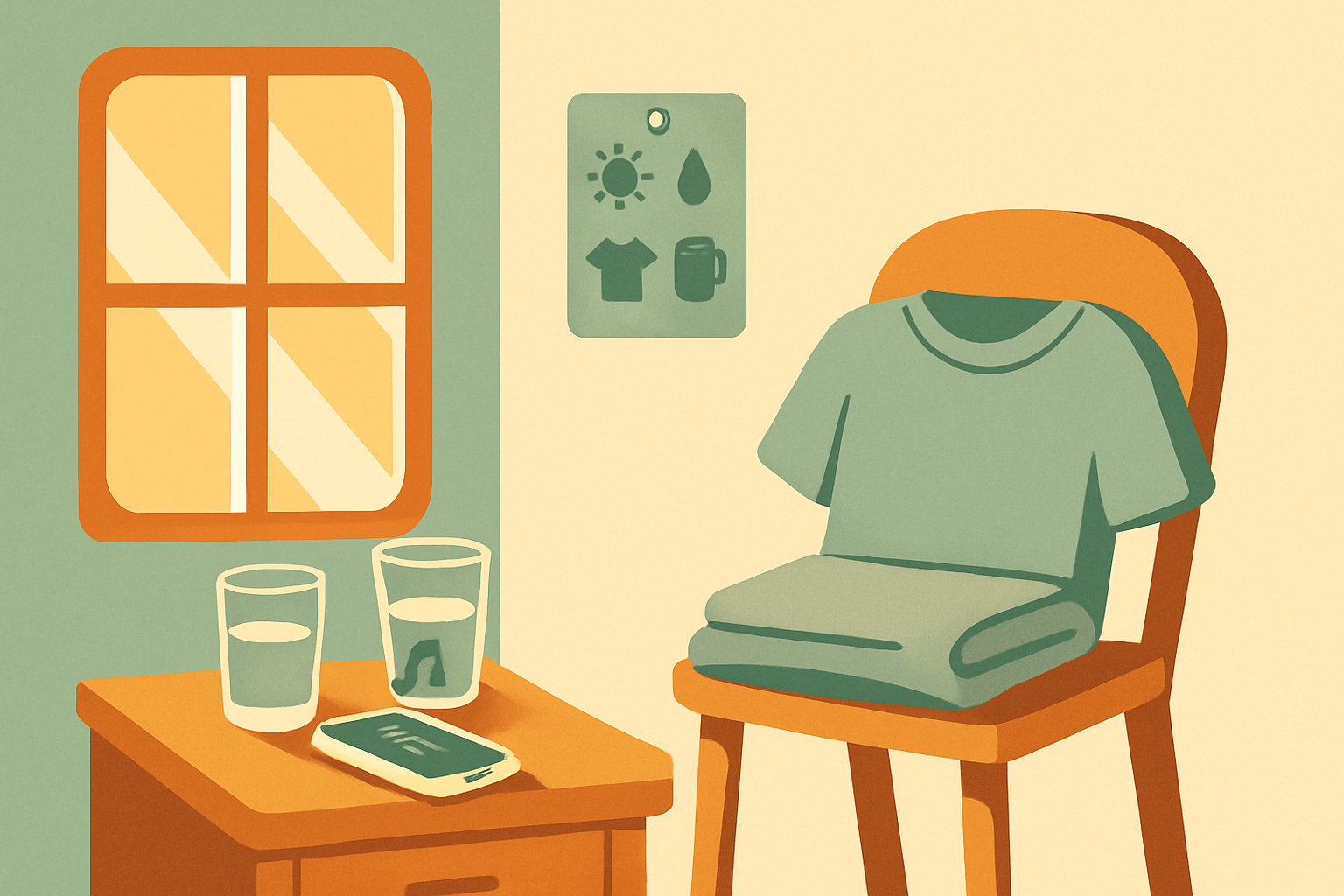
Lay your clothes out, fully, including socks and shoes. Set up the coffee or fill the kettle. Put anything you must leave with, keys, wallet, bag, headphones, in one spot by the door, sometimes called a launch pad. Decide breakfast now so it is not a 7 am negotiation. Fill a water glass and leave it on your nightstand. Each of these takes seconds at night and removes a whole decision from the morning, when decisions are most expensive.
A simple ADHD morning routine checklist
Here is a short, realistic ADHD morning routine checklist to adapt. It is deliberately small. Start with the anchors, add only what survives.
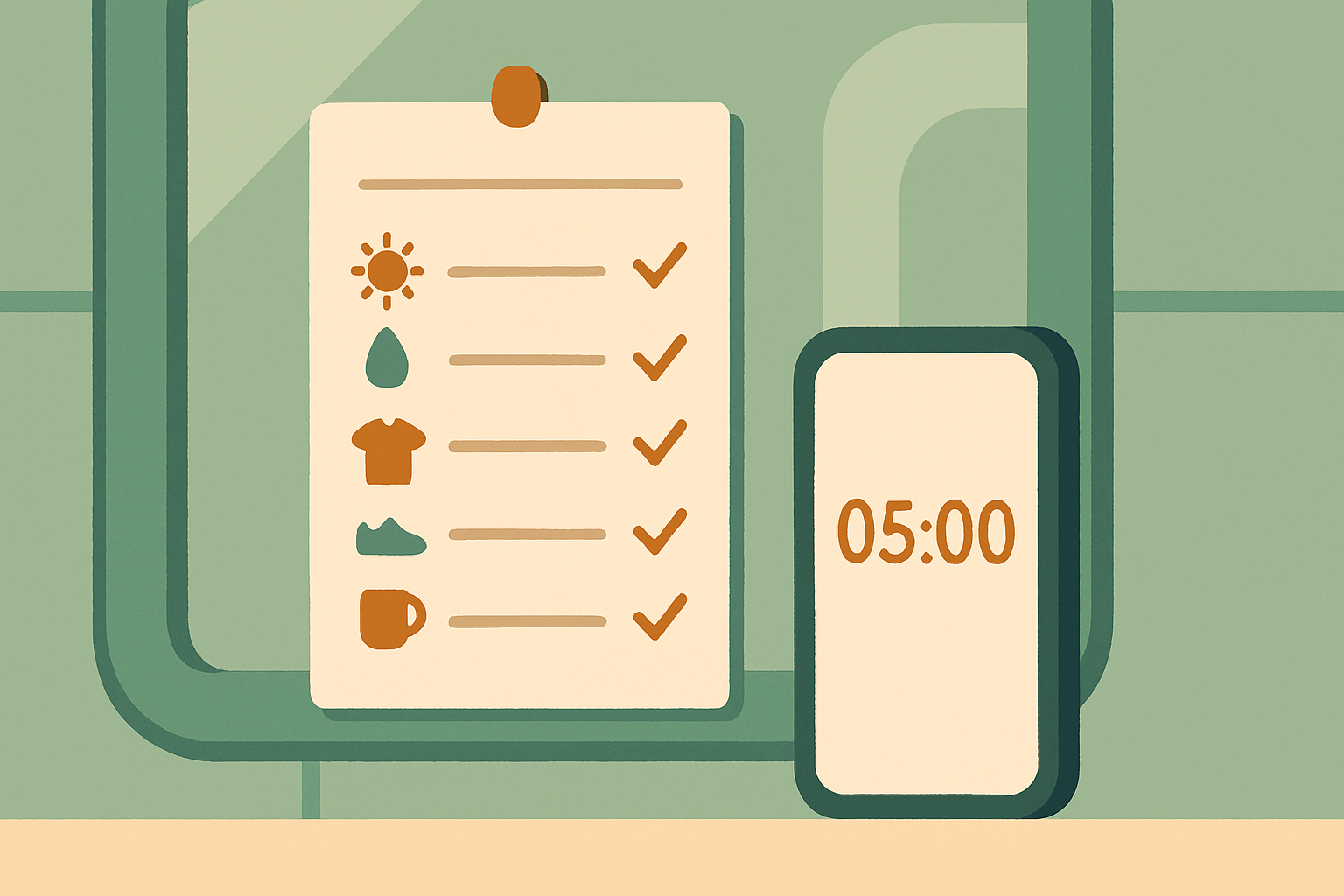
Wake to something stimulating, not jarring: an upbeat song or a podcast rather than a panic-inducing alarm. Drink the glass of water you left out. Get sunlight or bright light on your face for a few minutes, which helps shake off sleep inertia. Move your body for two minutes, a stretch, a short walk, anything. Get dressed in the clothes you already laid out. Eat the breakfast you already decided on. Do one tiny “win” task, like making the bed, for a small hit of momentum. Then check your list or calendar once, near the end, not the second you wake.
That is eight items, but the real routine is the first five. If a step does not earn its place after a week, cut it. A checklist you finish beats a checklist that is complete.
How do you make an ADHD morning routine actually stick?
The routine sticks when you stop relying on memory and willpower and start relying on your environment. Make it visible: a written or printed checklist on the bathroom mirror or fridge does the remembering for you, so the sequence lives on the wall instead of in your unreliable morning brain.
Use external timers for transitions. Time blindness means your internal clock cannot be trusted at 7 am, so let a phone or kitchen timer own each handoff: ten minutes to be dressed, five for breakfast. The timer, not your sense of time, keeps you moving. Habit stacking helps too: attach each new step to one you already do without thinking, like “after I start the coffee, I take my meds,” so the existing habit pulls the new one along. And keep the bar low enough that a bad night still allows a win. The version of the routine you can do exhausted is the version that actually builds the habit.
What if you fall off the routine?
You will fall off, and that is built into the plan rather than a sign it failed. ADHD runs on novelty, so a routine that felt effortless for two weeks can suddenly go stale, and a few rough nights can knock the whole thing over. That is normal. The skill is not falling off; it is restarting without the guilt spiral that usually follows.
When it happens, do not try to relaunch the full routine. Pick the single most load-bearing step, usually getting dressed or drinking water, and do only that tomorrow. One anchor is enough to start the chain again. Treat the routine as something you return to, not something you either keep perfectly or fail completely.
Tools that help with an ADHD morning routine
A routine lives or dies on whether you can see it and whether starting it feels rewarding, so the right tools target exactly those two things. A simple visible checklist, on paper or on your phone, covers the seeing. For the rewarding part, it helps to plan your wake-up dopamine in advance: I keep a free dopamine menu with quick “starter” ideas you can put right at the front of your morning, so the first thing you do is something your brain actually wants to move toward.
If you want ready-made options to drop into that first slot, my list of dopamine menu ideas has plenty of quick “starter” ones.
If apps suit you better than paper, several are built for exactly this kind of routine and reminder support. I keep an honest, current list of the best apps for ADHD, including habit and routine trackers that handle the reminding and the visual checklist for you. And for the harder mornings, when the problem is less “what is my routine” and more “I cannot get going at all,” a coping skills menu gives you a gentler set of options to reach for first.
One honest note to close. A good morning routine genuinely helps with the everyday friction of ADHD, but it is a support, not a treatment. If mornings are consistently overwhelming, or low mood and exhaustion are making it hard to function, that is worth raising with a doctor or an ADHD specialist rather than trying to fix it with a better checklist. Used for the ordinary hard mornings, though, a short, visible, slightly enjoyable routine is one of the most reliable ways to make the first hour of the day stop fighting you.