
You can usually feel when something was written by an AI before you can explain why. There is a smoothness to it, a faint plastic sheen. If you write with AI help and you want people to keep reading, learning to make AI writing sound human is less about tricks and more about removing the handful of tells that give it away.
I am a solo developer building in public under softDev23, and I use AI to help draft a lot of what I publish. I am not embarrassed about that. What I care about is that the result reads as if a person wrote it, because that is the only version worth a reader’s time, and the rules that get me there live in my AI-readable vault.
So here are the specific tells I hunt down, and the simple rules I use to keep AI-assisted writing honest and readable.
The goal is not deception
Let me be clear about what I mean, because there is a sleazy version of this. The goal is not to trick a reader into thinking no AI was involved, and it is definitely not to beat some detector. The goal is to make the writing good, and good writing happens to read as human.
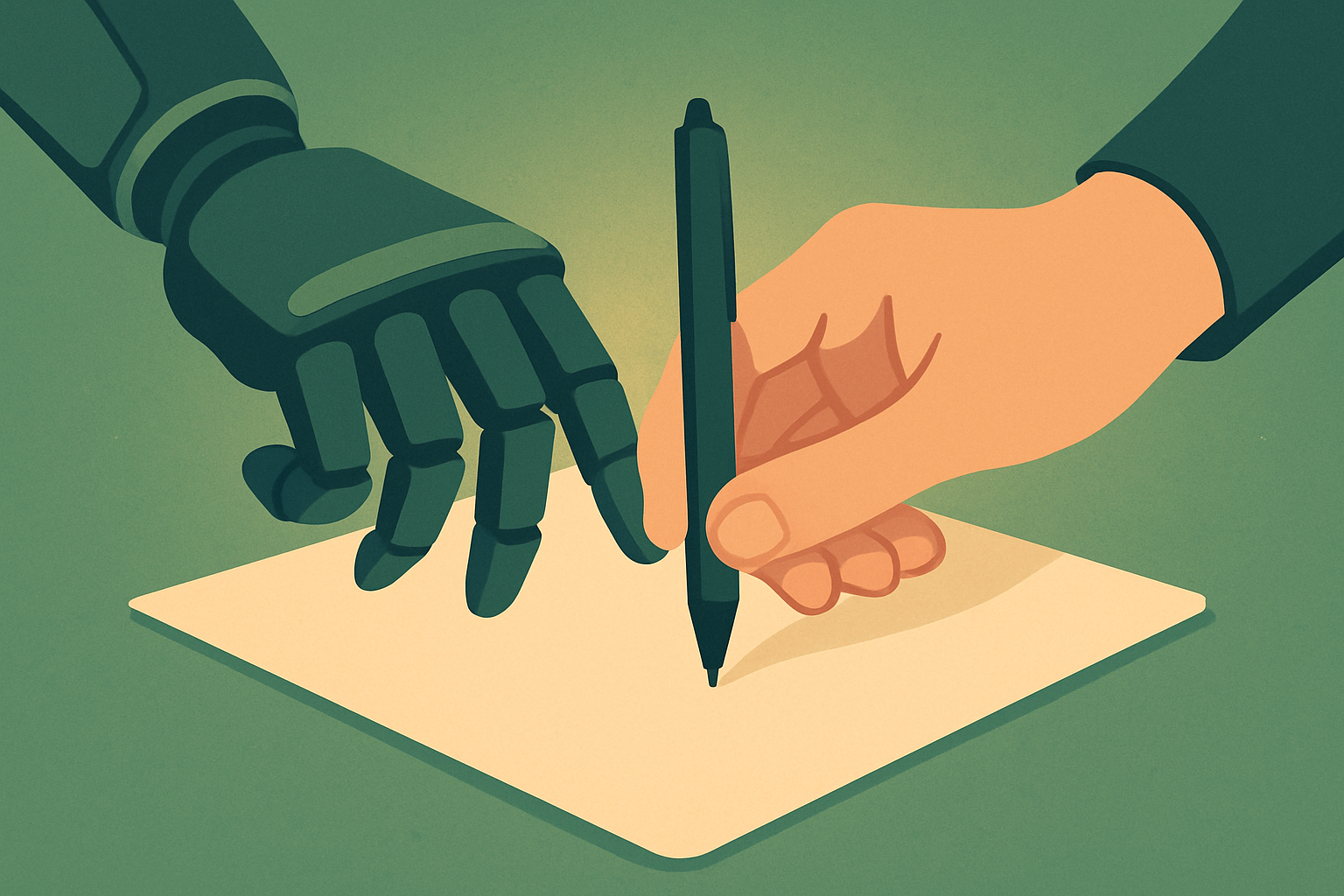
AI drafts tend to be competent and lifeless. They say correct things in a way nobody actually talks. Fixing that is not faking humanity. It is editing, the same work you would do on your own rough draft. The AI gets you a fast first pass. Making it sound like you is the real job.
If you keep that framing, everything else follows. You are not hiding the tool. You are doing the part the tool cannot, which is sounding like a specific person with a point of view.
Tell one: the em dash habit
The most famous tell is the em dash. AI models reach for that long dash constantly, dropping it into the middle of sentences to tuck in an aside, far more often than most people naturally write.
One or two are fine. The problem is the density. A paragraph with three em dashes in it starts to feel machine-made, because a human writer would have used a comma, a full stop, or just a simpler sentence. I cut almost all of them and rewrite the sentence to stand on its own.
The fix is rarely to swap the dash for another mark. It is to ask whether the sentence needed the aside at all. Usually, it did not, and removing it makes the line cleaner. The dash is often a symptom of a sentence trying to do too much at once.
Tell two: the colon tic
The one I had to train myself out of most recently is the colon. AI loves to set up a thought, drop a colon, and deliver the payoff. The reason is simple: it sounds authoritative.
Read that last sentence again. The colon there is exactly the move. Once you notice it, you see it everywhere in AI text, and it becomes its own kind of tell, the written equivalent of a stock phrase. A page full of these mid-sentence colons reads as generated even when every individual one is technically fine.
So I treat the colon like the em dash. Rare on purpose. Most of the time, the sentence is better as two plain sentences, or as one sentence with the colon simply removed. The authority you lose is fake authority anyway.
Tell three: hedged, listy smoothness
The subtler tell is rhythm. AI drafts often fall into a tidy, hedged cadence where every paragraph is the same length, every claim is softened, and everything is balanced into neat little pairs.
You see it in constructions like it is not just X, it is Y, and in endless on the one hand, on the other phrasing that never actually commits. It reads as careful, but it is really just non-committal. Humans with an opinion write unevenly. They land hard on the thing they care about and skim past the rest.
So I deliberately break the rhythm. A short, blunt sentence after a long one. An actual opinion, stated plainly, without three qualifiers protecting it. The writing should sound like someone who believes something, not a committee trying to offend no one.
Tell four: over-formatting
The last visible tell is structure. AI loves to chop everything into bullet points, bold half the words, and add a heading every two sentences. It looks organized. It reads as a slide deck.
Real prose mostly flows as paragraphs. I use lists when there is genuinely a list, and almost never otherwise. I bold things rarely, because when everything is emphasized, nothing is. Stripping out the excess formatting is one of the fastest ways to make a piece feel written rather than generated. The plain-language movement has long argued the same thing, and resources like plainlanguage.gov are a good reminder that clear and simple usually beats decorated.
Rules that make AI writing sound human
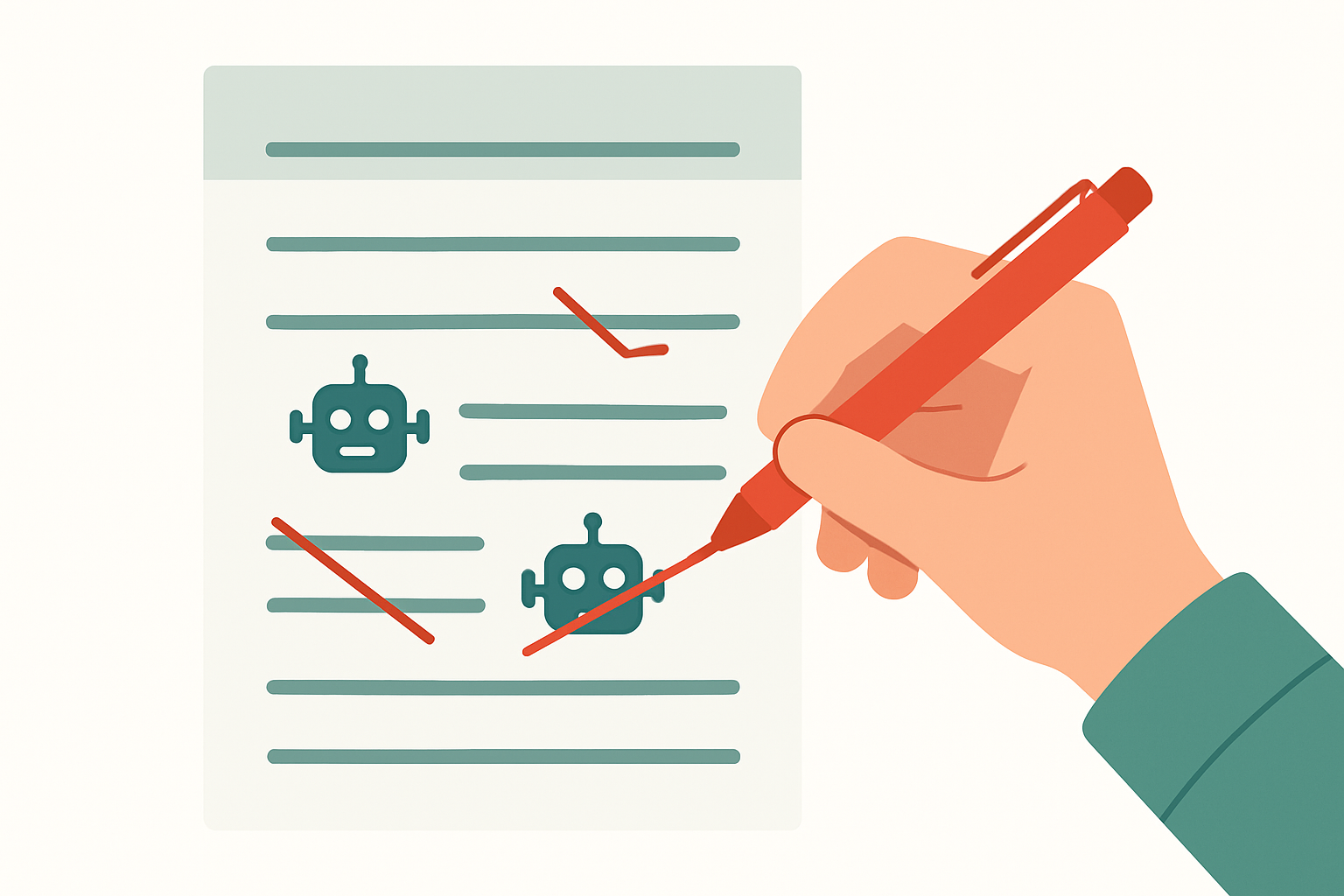
I turned all of this into a short checklist that I run on every AI-assisted draft, so I am not relying on catching tells by mood. Cut the em dashes to almost none. Keep colons rare. Break the even rhythm with at least one blunt, committed line. Use lists only for real lists, and bold sparingly. Read it out loud and delete anything I would never say.
That last one is the strongest test. If a sentence would feel strange coming out of my mouth, it does not survive, no matter how polished it looks on the page. The ear catches what the eye forgives.
I bake these rules into the system that drafts with me, which is part of the same setup I describe in my post on a reliable AI agent workflow. The rules live in a file the AI reads, so the first draft already avoids most of the tells instead of me cleaning them all up by hand.
If you already have a draft, try the “Make this shorter and clearer” prompt. Give it your text and tell it what must stay, then check that the revision still sounds like you.
Tell five: the empty opener and closer
Two more spots give AI away faster than anything in the middle, and those are the first paragraph and the last. AI loves to open with a grand throat-clearing line about how, in today’s fast-paced world, something is more important than ever.
Nobody talks like that, and readers bounce off it instantly. A human opener earns attention with a specific observation or a small admission, not a sweeping statement about the modern age. So I rewrite almost every AI intro to start with something concrete and a little personal, the way you would actually begin telling someone about this.
The closer has the opposite failure. AI tends to end by neatly restating everything it just said, in conclusion, as if the reader has the memory of a goldfish. A good ending adds one last useful thought or a small push to act, rather than summarizing. I cut the recap and leave the reader with something to do or think about.
Fix the opener and the closer, and a piece feels dramatically more human, because those are the two places a reader decides whether to start and how they feel when they finish. The middle can be solid and still be sunk by a robotic first and last line.
Let the AI do what it is good at
None of this means writing everything from scratch. That would waste the one thing AI is genuinely great at, which is getting words onto the page fast so you have something to react to.
The split that works for me is to let the AI handle structure and first-pass phrasing, then take over for voice and judgment. It is good at organizing a messy idea into a sensible order and at never facing a blank page. It is bad at sounding like a specific human who believes a specific thing. So I let it do the former, and I own the latter.
Thought of that way, the tells are just the seams where the machine did the human part badly. You are not fighting the AI. You are finishing its work in the places it cannot finish itself. The draft is a starting point, not a thing to be ashamed of, and not a thing to ship untouched.
Why this matters for building in public
For anyone publishing under their own name, this is not a cosmetic issue. Your writing is how people decide whether to trust you. Generic AI text quietly says nobody here cared enough to sound like themselves, and readers feel that even if they cannot name it.
I write about my work as a solo developer, and the whole point of building in public is that it sounds like an actual person figuring things out. The moment it reads as machine-smoothed filler, that trust leaks away. The AI can carry the draft. It cannot carry the voice.
So use the tool. It is genuinely useful, and pretending otherwise is just posturing. Then do the human part. Cut the tells, break the smoothness, say what you actually think, and read it aloud until it sounds like you. That is all it takes to make AI writing sound human, because at that point, it is not really AI writing anymore. It is yours.