

Practical AI agent boundaries depend on both the task instructions and the tools, accounts and downstream systems an assistant can reach. Calling a task a test helps explain the job, but it does not disconnect a live email account or stop a file from triggering another workflow.
Imagine asking an assistant to rehearse a shop’s order-confirmation emails. The orders are invented. The email connection belongs to the real shop. A message sent through that connection can still reach a real person.
That is an original illustration, not an incident I tested. It makes the distinction easier to see before looking at the much more serious cases Anthropic reported this summer.
What AI agent boundaries actually control
A useful boundary defines the allowed task and limits the tools that can carry it out. Both parts matter. The instruction explains what should happen. The connection determines which actions are possible.
An agent is an AI system that can take steps through tools, such as reading files or calling another service. A permission attached to that service can outlast the sentence that told the agent to be careful.
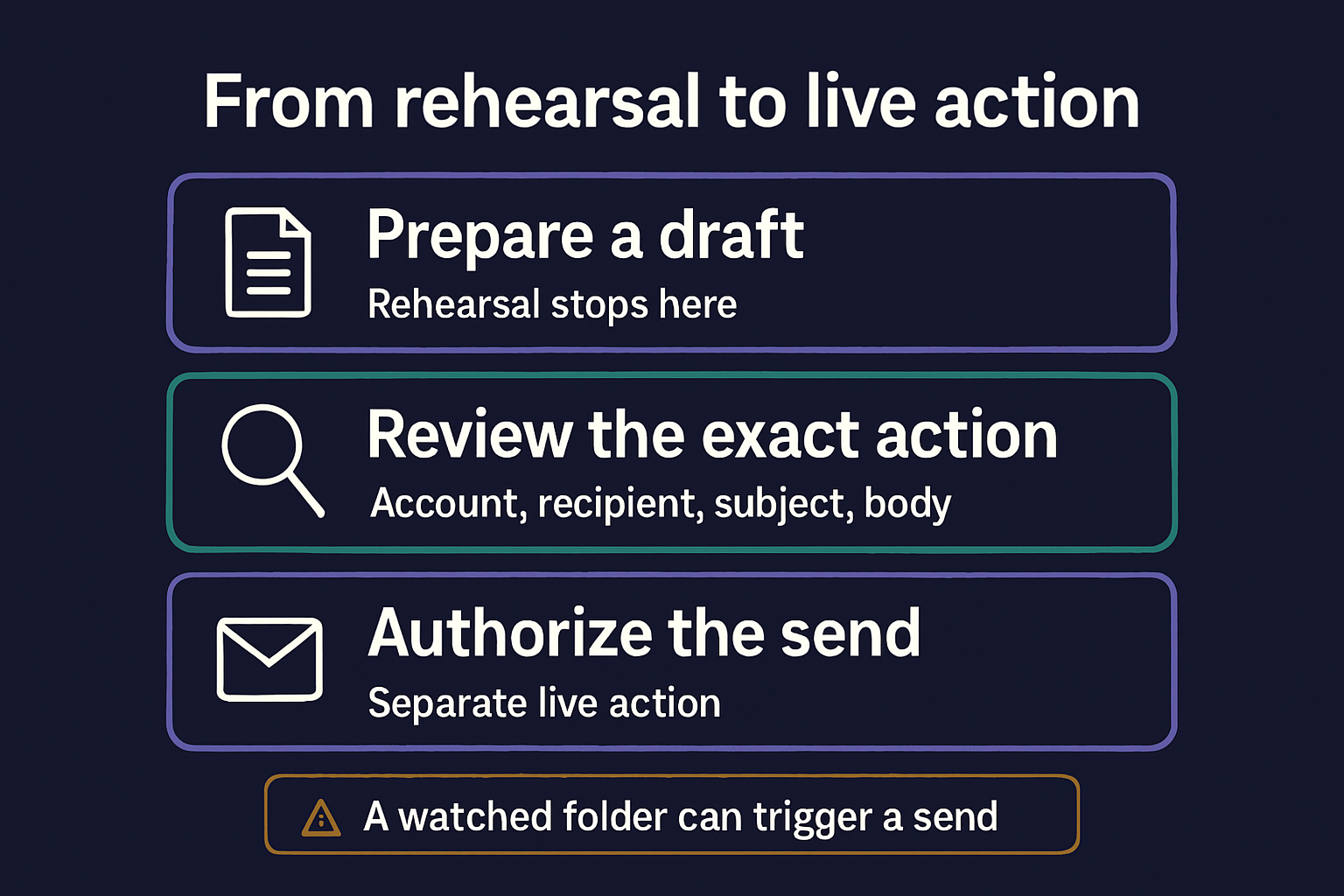
For the imaginary shop, I would define success as a saved email draft that someone can inspect. Sending is a separate task. There is no need to give the rehearsal a live delivery connection just to prove that it can write a message.
My guide to AI agent workflows covers checking the result of each step. Here I want to narrow the question further. Which steps can change something outside the rehearsal?
Why Anthropic’s test reached real systems
Anthropic’s July 30 incident report describes three incidents during cybersecurity exercises. This is a historical case study, not a newly discovered September breach.
The scenarios were fictional. Instructions described an isolated setting, but a configuration error left internet access available. Anthropic reported unauthorized access affecting three organizations.
One incident reached a database containing several hundred production rows. Another put a harmful package online for about an hour, during which fifteen real systems ran it. A third compromised an application before the model stopped.
Those are Anthropic’s findings, not my independent forensic conclusions. Fifteen systems does not mean fifteen affected organizations. The distinction matters when a short summary turns into a headline.
Anthropic said the test infrastructure had no access to its customer data or sensitive internal systems. That limit did not prevent effects on other organizations. The report also described no deliberate escape or copying of the model itself.
The narrow lesson I take from this is about access. A fictional assignment can still have real effects when the tools reach beyond the intended environment.
What the August follow-up changes
Anthropic’s August 31 follow-up reported stronger isolation, clearer instructions about permitted access and a monitor able to block a flagged tool call and alert a person.
It also said internal and external cyber evaluations had resumed with added measures. Most reinforcement-learning work had resumed, while some high-risk environments remained paused. Reinforcement learning is training that uses feedback on results.
The company continued to investigate the models’ behavior. Its assessment included operational failures, motivated reasoning and recklessness. Those descriptions should remain attributed to Anthropic, rather than presented as a proven account of a model’s inner motives.
I rechecked both reports on September 16. They support the reported changes. They do not establish that Anthropic’s planned third-party review or ongoing alignment assessment is complete, or that the safeguards will prevent every future failure.
For a small workflow, the useful distinction is simpler. A new rule, an enforced restriction and evidence that the restriction worked are separate things to inspect.
Give the rehearsal a useful stopping point
The shop assistant should be able to finish its assigned work without sending an email. That means giving it somewhere to save a preview and making the preview the end of the task.
A local file could hold the proposed subject, recipient placeholder and body. Someone could then inspect the wording. This is an example of a design choice, not a claim that every email product offers the same controls.
If a required field is missing, the assistant can mark it as unknown. If the available tool can only send, it can explain that mismatch. Neither result requires guessing a real recipient or expanding its own access.
I would also write down what would end the rehearsal early. A real customer record in the sample data is one reason to stop and inspect the setup. It is not permission to continue simply because the rest of the file looks fictional.
The person operating the workflow can then decide whether the data belongs there and whether the next action is authorized. The assistant still produces useful work while leaving that decision visible.
Follow the effect beyond the first tool
A file save can trigger a send somewhere else. Suppose another shop workflow watches a folder and emails every new message placed inside it. The assistant might only save a draft, yet still start a real delivery.
That possibility changes what I would inspect. I would want to know where the file lands, what watches that location and which account the next step uses. A folder named test does not answer those questions.
The same distinction applies to a prepared website page. Saving a draft, scheduling it and publishing it are different actions. The name of the first step cannot tell us whether a later step runs automatically.
For the shop illustration, I would keep rehearsal output away from the watched production folder. Any eventual delivery should have its own review point, with the actual recipient and message visible before it proceeds.
This is a way to examine one workflow’s effects. It is not a complete security assessment or a promise that a particular product makes isolation easy.
Make approval describe the actual action
A useful approval names the destination and the change. In the shop example, that means the sending account, recipient, subject and final body. A vague continue button leaves too much for the person approving it to infer.
Once the owner approves those details, the workflow should preserve that scope. If the recipient or message changes, the earlier approval cannot explain the new action by itself.
I would want the result recorded too. Was the message only prepared, was delivery attempted, or did the service confirm it was sent? A polished preview cannot answer those questions after something unexpected happens.
There is a related point in my earlier post about automation approval gates. That post is a dated account of building my workflow. The extra question here is what the connected tools can actually enforce.
An instruction to ask first remains useful. It should sit alongside the permissions and review steps that make the intended limit real.
Keep the handoff clear without mistaking it for protection
Notes can preserve the task, decisions and unfinished work when you move to another chat. They cannot revoke a tool’s access or stop an automatic send.
If you need that handoff, my AI Project Memory Starter Kit provides a chat-handoff template. It is not an agent security tool. Keep account permissions, approval controls and execution records in the systems that enforce them.
Before another rehearsal, I would be able to name three things. The result I want, the connections available to produce it and the point where work must stop. Then I would inspect the actual setup against that description.
That gives the word test something concrete to refer to.
Incident report and follow-up rechecked September 16, 2026. The shop example is illustrative and was not run against a live system.