


On day three, my content automation pipeline actually worked. Not in a way that the AI runs my business now. It’s in a much smaller, more useful way: an approved idea can now become drafts in the right places without me having to do the repetitive setup by hand every time.
This is part of my build-in-public series on creating an AI operating system.
The two days before this set it up. Day one was spent building the AIOS vault, so AI tools share a single source of truth. Day two was adding approval gates, so nothing public happens without my explicit yes. Day three is the payoff, where those rules finally have a working machine to run inside.
What the content automation pipeline does
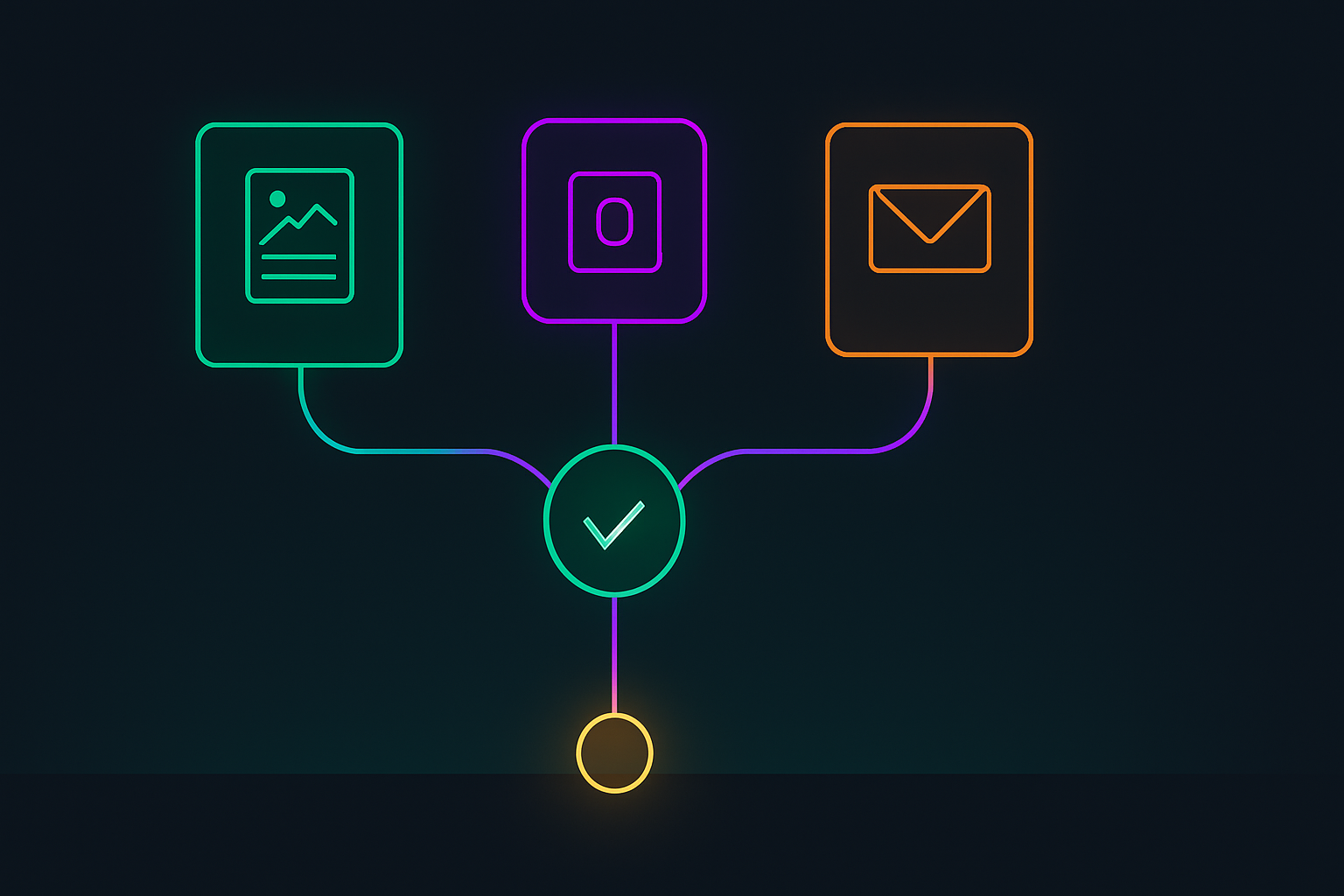
The pipeline connects one approval decision to three draft destinations. Airtable is the trigger, n8n routes the work, and the output lands as drafts in WordPress, Typefully, and MailerLite.
Here is the flow in plain terms:
- I approve an idea in Airtable. Airtable acts as the approval trigger.
- n8n picks that up and routes it to the right branches.
- The WordPress branch creates a blog draft.
- The Typefully branch creates a social draft.
- The MailerLite branch creates a newsletter draft.
I tested all three branches, and all three worked. One approved idea fanned out into a blog draft, a social draft, and a newsletter draft, each sitting in its tool waiting for me. I later extended the WordPress branch to generate its own featured and in-body images automatically, which I cover in my post on using the OpenAI image API for blog images.
Drafts, not publishing
The most important detail is what the pipeline does not do. It creates drafts. It does not publish, post, or send anything.
That is on purpose, and it is the same principle from day two carried into a live system. Draft first, approval second, publish last. The pipeline moves an approved idea into the place where I would finish and review it, and then it stops. Nothing goes public on its own.
This matters because it would have been easy to build the flashier version, in which approving an idea automatically sends a tweet, publishes a post, and emails a list. That version saves a few more minutes and removes the one safeguard I actually care about. I would rather press publish myself on three finished drafts than wake up to three things I did not get a final look at.
Why this is useful even though it is small
The value of the pipeline is not speed for its own sake. It is removing repetitive setup from work I already want to do.
Before this, turning one idea into a blog draft, a social draft, and a newsletter draft meant opening three tools, setting up three documents, and copying things between them. None of that is hard. All of it is friction, and friction is what stops me from being consistent.
The pipeline removes the setup and keeps the judgment. It does the boring part, which is creating the right draft in the right tool, and leaves the parts that need a human, which is deciding whether the idea is good and whether the draft is ready. That is exactly the split I want.
It also quietly changes my role. Instead of being the person doing every step, I am more focused on managing a small workflow. I approve, the pipeline prepares, I review, and I publish when it is ready. The work shifts from doing to directing, at least for content setup.
X progress and a monetization reality check
On the social side, I hit 33 followers. Small number, but the direction is right, and the replies-over-posting approach from the day before kept working.
I also spent time researching X monetization, mostly to be honest with myself about what this platform is for. The short version is that direct payouts are not a near-term goal for an account of my size.
What I found, in plain terms:
- Monetization for small creators is modest at best.
- The requirements to qualify are high relative to where I am.
- The likely revenue early on is low.
So I am not treating X as income. I am treating it as audience building, credibility, relationships, traffic, and validation. Those are the things a small account can actually get from showing up consistently and talking about real work. The money question, if it ever matters, is far down the road. Pretending otherwise would just lead to disappointment and bad decisions.
That reframing is freeing, honestly. If the goal is relationships and validation instead of payouts, then replies, build-in-public updates, and being useful are the whole strategy. I do not need the platform to pay me. I need it to connect me to people who care about the same things I am building.
Practical takeaway
If you want automation that helps without taking over, build a pipeline that creates drafts and stops there.
A few things that made this work for me:
- Use one clear approval trigger. Airtable holds the decision, so the pipeline only runs on things I have actually approved.
- Separate routing from output. n8n routes, and each branch has one job: a blog draft, a social draft, a newsletter draft. Easy to test, easy to fix.
- Keep drafts and publishing separate. The pipeline prepares. You publish. That single boundary is what makes the whole thing safe to use.
- Test each branch on its own before trusting the whole flow. I confirmed WordPress, Typefully, and MailerLite one by one.
And if you are growing a small audience, be honest about what the platform is for. For me, X is for relationships and validation, not revenue. That keeps my expectations and my effort pointed at the right things.
Final reflection
None of this means the machine is finished. It means the loop is finally visible: idea, approval, draft outputs, review, and publish later.
For a solo developer, that is a real step. Three days ago, the context for my work was scattered across chat histories. Now there is a vault that tools read, rules that keep automation in check, and a pipeline that turns an approved idea into drafts I can finish. It is small, not autonomous, and still depends entirely on my judgment. That is the version I wanted. I have since taken the WordPress side much further into a fully hands-off publisher, which I cover in my post on n8n WordPress automation.
The pipeline is the engine. The next thing I pointed it at was the softDev23 website itself, but that is a story for the next post.
That story is here: my AI website redesign, where I pointed the same draft-review-ship habit at rebuilding softdev23.com in a session.